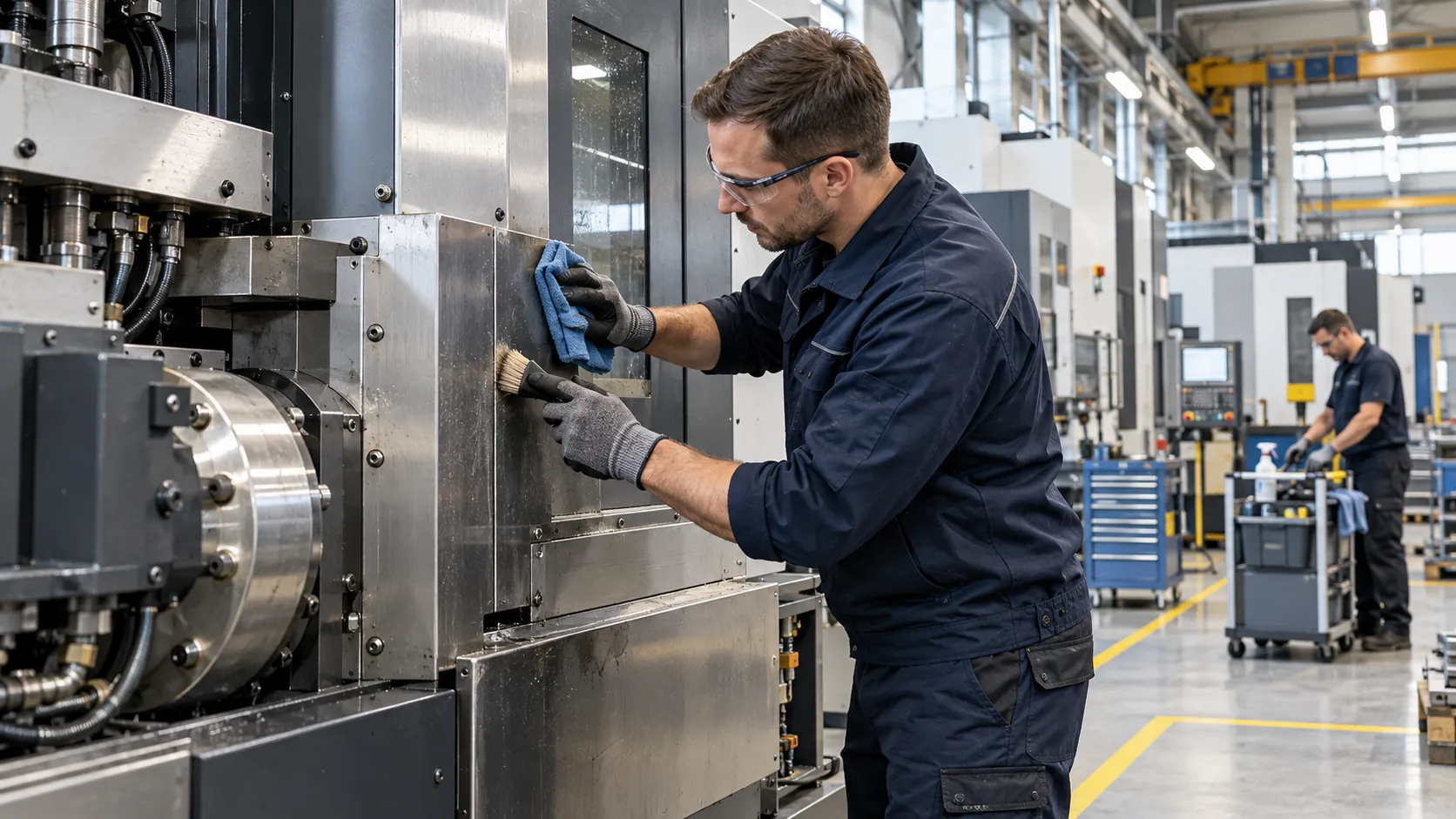
Cleaning the stainless-steel housing of a CNC machine with a brush and cloth on a production floor

Machine cleaning in Bremen: plant, metalworking fluid circuits and degreasing

What decides the method is not the contamination alone but the exclusion condition: electrics, seals, bearings, paint build-up and exposed precision surfaces set the framework.

Request a machine survey

Category
Industrial cleaning
Reachable
Mo–Fr 07:30–17:30 Uhr
Site visit
Free of charge, on site

In short

Machine cleaning removes swarf, oil and grease residues and deposits from machines, their surroundings and in part from metalworking fluid (cooling lubricant) circuits. It is less a cleaning decision than a method decision: every method has an exclusion condition, and for certain components the methods rule each other out. The framework is set by electrics, seals, manufacturer specifications and the operator's maintenance window.

Problem und Lösung

The challenge

The trigger is rarely 'the machine is dirty'. What is typical are concrete findings: slideways become clogged, scoring and rejects appear, and the cause lies somewhere between swarf and lubricant. The emulsion smells after the weekend, the workforce complains of skin problems. Conductive dust has settled in the control cabinet, and the control system has already failed once. In summer the motor and the hydraulic power unit run into thermal shutdown. Maintenance is scheduled for two days, cleaning is meant to happen in the same window, and afterwards the machine has to produce again. On top of that comes the open question of whether water may be used at all – electrics and seals are a concern. The actual brief is therefore: a method decision with reasoned exclusions, embedded in a tight time window and in the machine's documentation.

Our solution

Cleaning is planned as part of maintenance, not alongside it. First, materials, surfaces, seals, paint build-up, electrics, gearboxes and exposed precision surfaces are recorded; from that follows which method is permissible for which assembly and which is explicitly excluded. The machine manufacturer's cleaning and maintenance instructions are also evaluated – they are the narrower framework than any general method recommendation. Before work on electrics, hydraulics and pressurised parts, the plant is isolated according to the operator's lock-off procedure. Material is removed in a fixed sequence: first dry, whatever can be removed dry, then the assemblies with the method defined for them, in each case with demarcation of adjacent areas. Then corrosion protection on bare surfaces, restoration of the lubrication points and disposal of the residues. Finally a visual inspection, removal of covers and aids, documentation and release by the maintenance function.

Scope of service

  • Machine survey and method decision: materials, surfaces, seals, paint build-up, electrics, gearboxes and exposed precision surfaces are recorded – from that follows which method is permissible for which assembly and which is explicitly excluded.
  • Machine tools, robots and the plant surroundings: removal of swarf, oil and grease residues, abrasion and deposits on housings, beds, trays and surrounding surfaces.
  • Value-preserving degreasing: removal of resinified lubricants and greases as preparation for maintenance and recommissioning.
  • Electrical areas set the framework: a live machine or control cabinet is not treated with water or wet media, and before work begins the plant is isolated according to the operator's lock-off procedure. Whether and to what extent work near control systems is to be carried out must be clarified before the deployment.
  • The metalworking fluid circuit as a separate service item: extraction of the used emulsion, flushing of lines and tanks, refilling and restoration of the emulsion parameters are work steps to be calculated separately with their own evidence. This service must be expressly commissioned in the schedule of services and kept separate from the rest of the cleaning.
  • Removal in the right sequence: whatever can be removed dry is removed dry first. Anyone who wets swarf and solids first spreads them into channels, trays and circuits.
  • Manual and solvent-based degreasing in places that neither a blasting jet nor a water jet reaches – subject to material compatibility, evaporation, occupational safety and drying time before recommissioning.
  • Post-treatment: corrosion protection on bare surfaces during maintenance and standstill, restoration of the lubrication points and orderly disposal of the residues.
  • Recommissioning and handover: visual inspection, removal of covers and aids, documentation of the work and release by the maintenance function.
  • Demarcation: the service ends where maintenance begins. Cleaning is not the replacement of wear parts, not repair and not inspection.

Typical subservices

  • Machine survey and method planning
  • Machine tools and plant surroundings
  • Robot cells and handling
  • Degreasing and preparation for maintenance
  • Assemblies and small parts outside the machine
  • Post-treatment and corrosion protection
  • Recommissioning and handover

Suitable for

  • Machining: CNC milling and turning centres, machining centres with a metalworking fluid circuit, swarf conveyors, tool changers, clamping devices and fixtures.
  • Forming and presses: press lines, tools and casting moulds with deposits of release agents and scale.
  • Plastics processing: injection moulding machines with release agent and outgassing residues, temperature control units, granulate conveying.
  • Assembly and handling: robot cells, gripper systems, linear and gantry systems with lubricant and dust ingress.
  • Supply units: hydraulic power units, cooling units, compressors, filter and separator units as part of the plant.
  • Parts and components: filters, valves, nozzles, clamping devices and small parts that are cleaned outside the machine.

Your advantages

Tailored to this service – aligned with site and industry.

  • Every method has an exclusion condition

    Dry ice removes brittle deposits, but it is not the first choice for tenacious grease layers and sensitive seals. High pressure dissolves grease effectively, but introduces moisture into electrics, gearboxes and bearings. Sound planning states these exclusions openly.

  • The circuit is a chemistry problem

    A machine can look clean and the metalworking fluid circuit still be unusable. After flushing, the freshly made-up emulsion has to reach its parameters again: concentration, pH value and microbiological load.

  • The sequence decides the downtime

    During running production, only dry work in sections is realistic. Everything else belongs in a maintenance or shutdown window and is sequenced with the mechanical work: clean first, then lubricate and cover precision surfaces, then recommission.

Process

How your project runs

  1. 1

    Machine survey

    Materials, surfaces, seals, paint build-up, electrics, gearboxes and exposed precision surfaces are recorded. The result is the method decision per assembly, including the excluded areas.

  2. 2

    Manufacturer documentation and lock-off

    The manufacturer's cleaning and maintenance instructions are evaluated. Before work on electrics, hydraulics and pressurised parts, the plant is isolated according to the operator's lock-off procedure; a maintenance contact releases the work.

  3. 3

    Dry removal first

    Whatever can be removed dry is removed first – swarf and solids before anything else. If they are wetted, they spread into channels, trays and circuits.

  4. 4

    Cleaning per assembly

    Each assembly is treated with the method defined for it, and adjacent areas are demarcated. Then corrosion protection on bare surfaces, restoration of the lubrication points and disposal of the residues.

  5. 5

    Recommissioning and handover

    Visual inspection, removal of covers and aids, documentation of the work and release by the maintenance function. Only then does the machine return to production.

Methods and equipment

  • The manufacturer's documentation sets the framework: the machine manufacturer's cleaning and maintenance instructions are the narrower yardstick than any general method recommendation.
  • Dry before wet: whatever can be removed dry is removed dry first. Anyone who wets swarf and solids first spreads them into channels, trays and circuits.
  • Every method has an exclusion condition. Dry ice removes brittle deposits and introduces no moisture, but it is not the first choice for thick, tenacious grease layers or for surfaces with sensitive seals or optical components; it generates noise, and in pits and confined machine areas the carbon dioxide concentration has to be kept under control.
  • High pressure with water and heat dissolves grease very effectively, but introduces moisture into electrics, gearboxes, bearings and sealing gaps, generates aerosols and leaves waste water that may contain oil. For assemblies with sensitive electrics or exposed precision surfaces it is therefore excluded.
  • Solvent-based and manual degreasing also works in places that neither a blasting jet nor a water jet reaches, but it requires attention to material compatibility, evaporation, occupational safety and drying time before recommissioning.
  • The method sequence is defined before the deployment: several methods on one machine mean more set-up time, more demarcation of adjacent areas and more follow-up work.

Technical and legal framework

This service sits within a framework of statutory duties, technical rulebooks and operational practice. The distinction matters because it determines who is responsible for what.

The machine remains a machine electrically
A live control cabinet or machine is not treated with water or wet media. For work with electrical installations and equipment, DGUV Vorschrift 3 applies as an accident prevention regulation – binding for member businesses. The Industrial Safety and Health Ordinance additionally obliges the operator to carry out maintenance and recurring inspections. The practical consequence: cleaning and electrical work follow the same lock-off procedure, and responsibility for isolating lies with the operator.
The circuit is a chemistry problem, not a visual one
A machine can look clean and the circuit still be unusable. After flushing, the freshly made-up emulsion has to reach its parameters again: concentration, pH value and microbiological load. Residues of cleaning agents can destabilise a new emulsion, cause it to turn or form foam. TRGS 611 is a binding Technical Rule for Hazardous Substances with presumption effect under the Hazardous Substances Ordinance: whoever complies with it may assume that the Ordinance is met. In addition, DGUV Regel 109-003 describes the recognised state of the art for activities with metalworking fluids – it is not a legal norm, but becomes relevant through practice, supervision and insurance effect. For TRGS 611 the following applies: professional review of the rule in its full text is required.
Dry ice is a gas method with side effects
Carbon dioxide is heavier than air and collects in pits, trays, sumps and confined machine rooms. Work there requires ventilation, measurement and a clear rule on who enters when. Dry ice blasting also creates a very dry environment; in professional practice, electrostatic charging is controlled by earthing and suitable measures. Both belong in the risk assessment, not in a footnote.
Manufacturer specifications take effect contractually
Specifications of the machine and module manufacturer on cleaning – permissible agents, pressure, temperature, areas that must not be opened – are not a legal norm, but take effect through the purchase contract, through maintenance contracts and through the manufacturer's warranty terms. Anyone who disregards them risks claims. The manufacturer's documentation therefore belongs in the planning, not in the follow-up.
Waste water and disposal
Waste water containing oil or emulsion from cleaning is subject to water law. WHG and AwSV are legally binding; discharge requires an official permit and technical separation. Used emulsion, swarf, sludges and cleaning waste water must be routed to an orderly disposal path. Who keeps the evidence and whether the in-house acceptance point or an external facility is used belongs in the quotation. For the water law requirements the following applies: professional review of the standard in its full text is required.
The boundary with maintenance
Cleaning is not the replacement of wear parts, not repair and not inspection. Conspicuous findings – scoring on slideways, imbalance, leakage, condition of the seals – are passed on to maintenance, not silently dealt with as part of the job. This boundary belongs expressly in the quotation, so that responsibility for the condition of the machine does not blur.

The rulebooks named here describe requirements for how the work is carried out – they are not a certification held by BREREI. VDI and DIN normative texts are chargeable and were not available in full; where a statement touches the normative detail, this is noted in place.
What determines the interval

  • Soiling rate and tightness of the machine: open machining with aerosol formation produces more deposit than an encapsulated system.
  • Type of metalworking fluid and service life: emulsions age, become contaminated with microorganisms and lose their lubricity. Circuit care is paced by service life and measured values, not by the calendar.
  • Condition of extraction and enclosure: where mist and dust are carried away, less remains on the machine.
  • Machine criticality: a machine with tight tolerances and high utilisation is cleaned more often and more carefully than a standby machine.
  • Maintenance plan and shutdown calendar: cleaning is attached to existing maintenance windows, which usually produces a combination of short partial cleanings and one cleaning during standstill.
  • Manufacturer specifications: where the manufacturer prescribes intervals or inspections, these take precedence over operational habits.
  • Observed symptoms: rising reject rates, thermal shutdowns, odour in the circuit, skin complaints and dust in the control cabinet are triggers, not intervals.

What determines the effort and the quotation

  • Accessibility of the assemblies: whether an assembly is removed or cleaned in place is the largest single factor – and it depends on whether workpieces and fixtures have been cleared beforehand
  • Combination of methods: several methods for one machine mean more set-up time, more demarcation of adjacent areas and more follow-up work
  • Extent of the electrical work in the surroundings: isolation, covering and recommissioning take time, even if they do not look like cleaning
  • Circuit treatment: extraction, flushing, disposal, refilling and parameter setting are work steps in their own right with their own evidence and must be listed separately in the schedule of services
  • Disposal effort: quantity and type of the residues, emulsion content, need for accompanying waste notes and the distance to the acceptance point
  • Downtime window: the same scope in one block is more favourable than spread across several night shifts
  • Preparation by you: clear access, cleared workpieces and fixtures, storage areas for equipment and containers, connections for power, water and compressed air, and an extraction option in the working area. Whatever is missing is made up during the window – at the window's expense
  • Documentation requirement: report, photographic documentation, details of circuit parameters and the documented release by the maintenance function

Applicable standards and regulations

  • Gefahrstoffverordnung (GefStoffV) – Hazardous Substances Ordinance, legally binding
  • TRGS 611 – Technical Rule for Hazardous Substances with presumption effect under the GefStoffV, not a standalone statute
  • DGUV Vorschrift 3 – accident prevention regulation, binding for member businesses
  • DGUV Vorschrift 1 – accident prevention regulation, binding for member businesses
  • DGUV Regel 109-003 – DGUV Regel, not a legal norm, recognised state of the art
  • Betriebssicherheitsverordnung (BetrSichV) – Industrial Safety and Health Ordinance, legally binding
  • WHG / AwSV – legally binding
  • Manufacturer specifications of the machine and module manufacturers – effective through the purchase and maintenance contract, not a legal norm

These references describe the requirements the work is performed against. They are not a certification, inspection or approval held by BREREI.

Frequently asked questions about this service

Short answers to help you assess whether this service fits your site.

Does the machine have to be dismantled for cleaning?

Not as a matter of principle. Whether an assembly can be cleaned in place depends on the method and on accessibility: dry methods with extraction get further without dismantling than wet methods that flood gaps and seals. Where precision surfaces, seals or electrics are affected, partial removal is nevertheless the safer solution. The decision is taken during the machine survey, not during the deployment.

When is dry ice useful and when is it not?

Dry ice removes brittle deposits without leaving blasting agent residues and without introducing moisture – that is its advantage in electrical and sensitive areas. For thick, tenacious grease layers it is not the most effective method, it generates noise, and in pits and confined machine areas the carbon dioxide concentration has to be kept under control. These exclusion conditions belong before the decision, not after it.

May high pressure be used on the machine?

Only where water and aerosol cannot cause damage. The critical points are electrics, control cabinets, gearbox breathers, bearings, sealing gaps, exposed slideways and anything that can corrode later. After wet cleaning, drying, preservation and a visual inspection are necessary, and the oily waste water must be routed to an orderly disposal path.

Is the metalworking fluid circuit cleaned as part of the work?

That is a service in its own right with its own requirements and belongs separately in the schedule of services. After the used emulsion has been extracted and the system flushed, the newly made-up emulsion has to reach its parameters again; residues of cleaning agents can destabilise it. Ask explicitly whether extraction, flushing, refilling and disposal of the used emulsion including evidence are included. The technical basis for activities with metalworking fluids is TRGS 611 – a binding Technical Rule with presumption effect, supplemented by DGUV Regel 109-003 as the state of the art.

How much downtime does the cleaning cause?

That cannot be answered in general terms. During running production, only dry work in sections is realistic. For everything else, cleaning is placed into an existing maintenance or shutdown window and sequenced with the mechanical work: clean first, then lubricate and cover precision surfaces, then recommission. Anyone who treats cleaning as an afterthought in an already fully planned window extends the downtime.

Who is liable if damage occurs after cleaning?

Responsibility follows the cause. The wrong choice of method on a sensitive component is an error by the service provider; a component that fails despite correct working practice is a maintenance matter. A condition survey before the start – photographs, visual inspection, documented anomalies – is therefore the most effective instrument for both sides. It does not replace acceptance, but it makes acceptance robust.

Industries where this service is used

The industry page sets out which requirements apply there.

Plan machine cleaning inside your maintenance window

State the type of machine, the assemblies affected, the metalworking fluid and the maintenance window in which work is possible. After the machine survey, the quotation names the method per assembly, the areas expressly excluded, your preparation, the disposal route and the acceptance criteria – firm commitments on costs and dates are not given in advance.

Prefer to talk?

0421 87757597

Mon–Fri, 07:30–17:30 – we are happy to call you back.

Request a quote in two minutes

Service, property and contact details – that is all we need.

Or use the full contact form