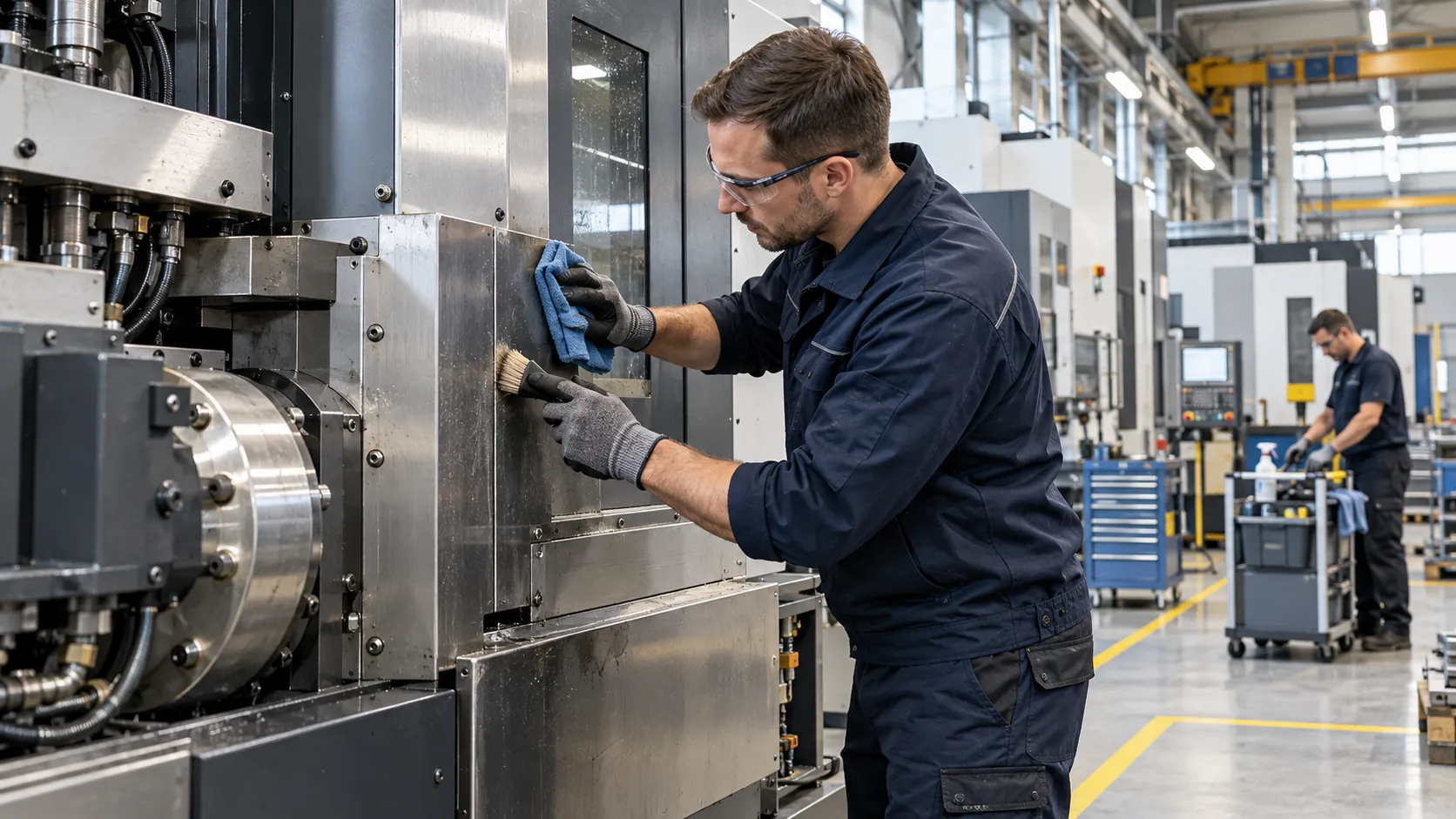
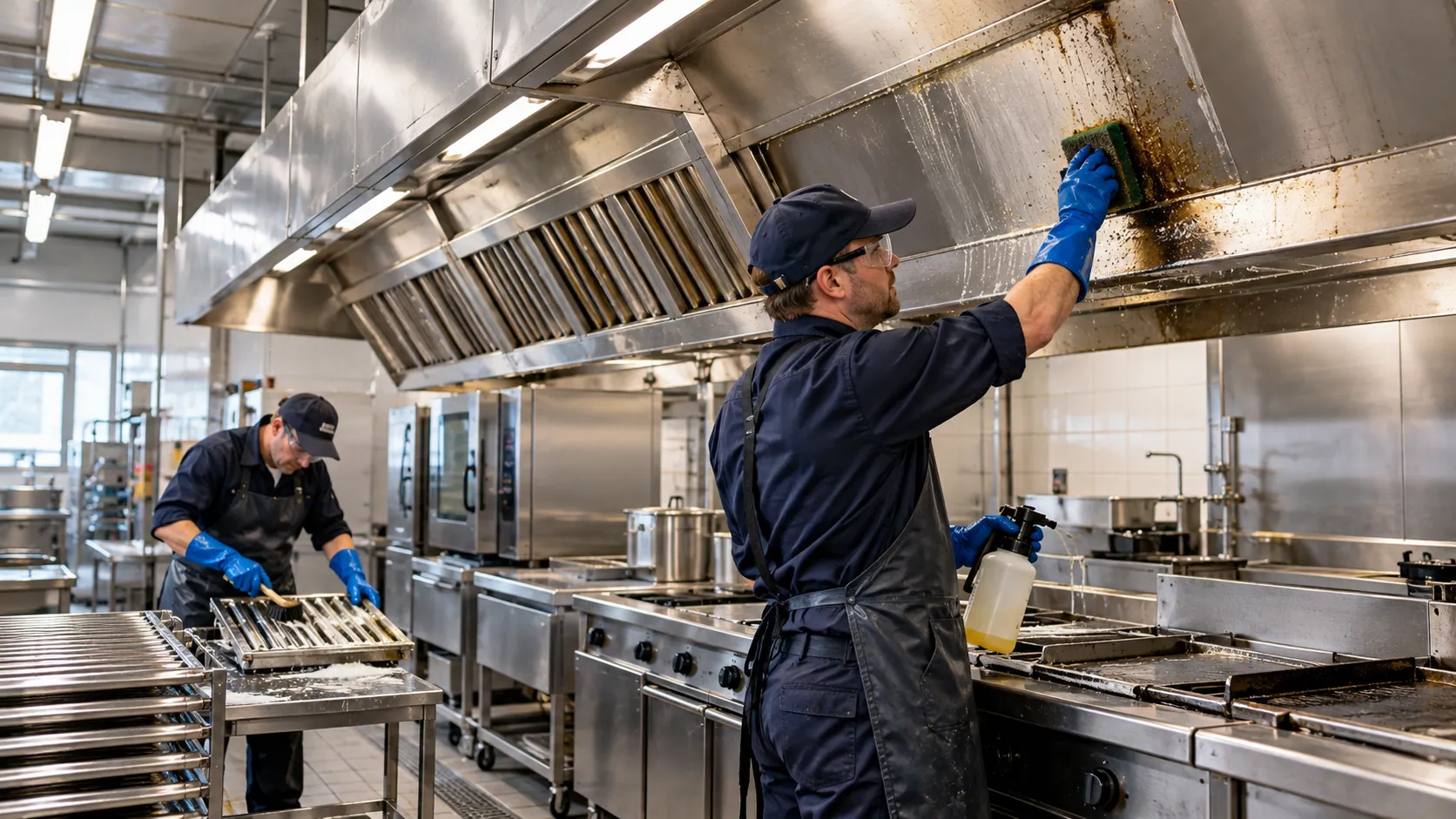
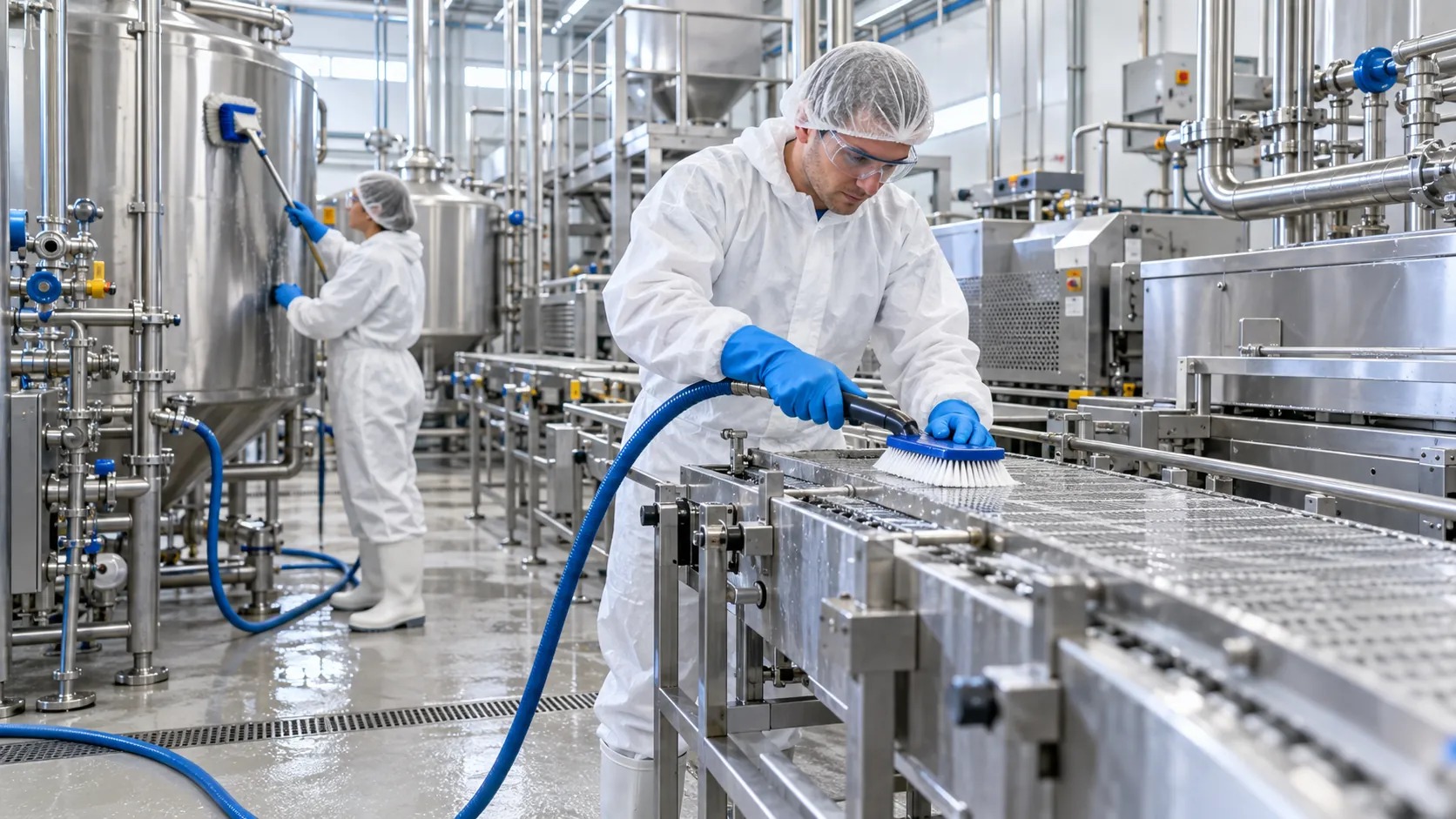
Hygienic cleaning of a stainless-steel conveyor in food production, in protective clothing

Plant cleaning in food production: biofilm, allergens and evidence

What decides the outcome is not the visible surface but the order of the steps: disinfection only works reliably once fat, protein and mineral deposits have been removed beforehand.

Agree the procedure

Category
Industrial cleaning
Reachable
Mo–Fr 07:30–17:30 Uhr
Site visit
Free of charge, on site

In short

In food production what counts is not visible cleanliness but the residue profile that has been removed: fat, protein, minerals and biofilms must be eliminated in the sequence alkaline, acid, rinse, disinfect – if a step is skipped, the cause remains on the plant. Responsibility for HACCP and food safety remains with the food business operator; a contractor supplies the cleaning and its documentation.

Problem und Lösung

The challenge

Food businesses have long had a system for cleaning: cleaning plans, responsible persons, evidence, audits. It becomes difficult in three places. First, the plant dictates cleanability: conveyor screws, mixers, filling nozzles, seals, weld seams, dead corners and valve seats are the places where residues survive – a point that is poorly accessible by design does not improve by scrubbing for longer. Second, evidence is not self-explanatory: an ATP value below a threshold shows little organic residual material, but not that no pathogenic germs are present; anyone who fails to make that distinction bases a release decision on a misunderstanding. Third, cleaning competes with production time: if contact time is shortened or the order is swapped, the result no longer matches the agreed procedure. The roles must be kept separate here: the operator and food business operator is the producer, the client for the cleaning may be the same business or a group structure, and the contractor carries out the cleaning according to the agreed procedure.

Our solution

At the start stands the agreement of the procedure: hygiene zones, plant design, product residues, release criteria and the permissible agents are clarified with the client. The deployment then follows the chemistry of the residues. First, dry clearance so that water does not spread loose residues over the whole plant. Pre-rinsing follows with a deliberately chosen temperature, because water that is too hot denatures protein and bakes it on. The alkaline stage removes fat and protein, the acid stage mineral deposits such as lime and milk stone. Then clear rinsing and checking of the pH value, because otherwise cleaning agent residues neutralise the disinfectant. Only on the clean, neutral surface does disinfection follow, according to the specified concentration and contact time. Assessment, release and documentation close the sequence – the operator grants the release of the plant for production.

Scope of service

  • Procedure agreement: hygiene zones, plant design, product residues, release criteria and permitted cleaning and disinfection agents are clarified with the client before the deployment.
  • Dry pre-cleaning: loose product is cleared before water is used – otherwise the residues spread over the entire plant.
  • Pre-rinsing: loosening of coarse residues with a deliberately chosen water temperature so that protein does not denature and bake onto the surface.
  • Alkaline cleaning: removal of fat and protein with an agreed concentration, temperature and contact time; demineralised water improves the effect and avoids deposits.
  • Acid intermediate cleaning: removal of mineral deposits such as lime, milk stone and beer stone; it supports the loosening of deposit layers.
  • Clear rinsing and pH control: cleaning agent residues are removed and the pH value is checked before disinfection.
  • Disinfection: application of approved agents and methods as specified, with documented concentration and contact time.
  • Machines and plant: conveyor belts, mixers, filling and packaging lines and pipelines in open procedures.
  • Cold and climate areas: evaporators, fins and condensate areas in cold rooms, treated with low aerosol – water freezes there, and aerosols are critical.
  • Documentation: cleaning report with plant reference, agents, concentrations, times, findings and deviations.

Typical subservices

  • Procedure agreement and hygiene zones
  • Dry pre-cleaning and pre-rinsing
  • Alkaline cleaning
  • Acid intermediate cleaning
  • Disinfection of product-contact surfaces
  • Cold and climate areas
  • Cleaning documentation

Suitable for

  • Meat and fish processing – wet environment, high protein and fat load and hygiene zones with strict separation.
  • Dairies and beverage filling – frequent product changes, allergen and microbiology windows, high importance of water quality.
  • Bakeries and confectionery – flour dust and dry products, plus fat as well as egg and sugar deposits; dry cleaning carries its own weight here.
  • Coffee roasteries and businesses with dry products – dust and bulk material flows in which moisture has to be avoided.
  • Chilled and frozen areas – condensate, frost and finned evaporators; low-aerosol or dry methods are often the more suitable choice here.
  • Businesses with open product contact – conveyor belts, cutting machines, mixers, moulding plant and fillers; here accessibility decides the result.

Your advantages

Tailored to this service – aligned with site and industry.

  • Biofilm is a matrix, not a film

    Microorganisms sit in a matrix of extracellular polymeric substances that acts as a diffusion barrier: disinfectants reach the enclosed cells poorly, and organic residues consume the active substance. That is why removal of the matrix comes before disinfection.

  • HACCP remains the business's task

    Regulation (EC) No 852/2004 obliges the food business operator to work according to HACCP principles. A contractor supplies cleaning and documentation and supports this system – it does not take it over.

  • Time pressure leaves the procedure behind

    Cleaning competes with production time. If contact time is shortened or the order swapped, the validation is no longer valid – even if the plant looks clean on the outside.

Process

How your project runs

  1. 1

    Agree the procedure

    Hygiene zones, plant type, product residues and permissible agents are clarified; the client's release criteria and sampling plan are recorded.

  2. 2

    Dry before wet

    Loose residues are cleared, then pre-rinsing takes place with a deliberately chosen temperature. Anyone who rinses first spreads product residues over the whole plant.

  3. 3

    Clean alkaline and acid

    The alkaline stage acts against fat and protein, the acid stage against mineral deposits. Concentration, temperature and contact time follow the soiling and the material.

  4. 4

    Rinse clear, check pH, disinfect

    Cleaning agent residues are rinsed out and the pH value is checked before disinfection. Agent, concentration and contact time follow the manufacturer's specification and the client's release.

  5. 5

    Assess, have released, document

    Visual inspection; whether a rapid test is additionally run according to the client's sampling plan is agreed in advance. The operator grants the release of the plant for production. The report records plant, section, agent, concentration, time, personnel, finding and deviation.

Methods and equipment

  • Dry pre-cleaning before every wet stage: clearing and collection of loose product residues so that water does not spread them over the plant.
  • Pre-rinsing with a deliberately chosen water temperature so that protein does not denature and bake onto the surface.
  • Alkaline cleaning against fat and protein, acid cleaning against lime, milk stone and beer stone – in alternation, because organic and mineral deposits only dissolve completely that way.
  • Clear rinsing with pH control before disinfection; a disinfectant only works reliably on a clean, neutral surface.
  • Low-aerosol or dry working in open product zones, cold areas and dry areas; high-pressure cleaning is not automatically the more suitable method there, because it can spread germs and residues via aerosols.
  • Closed systems such as tanks, pipelines and heat exchangers are usually cleaned by the CIP method; time, temperature, concentration and flow are validated and monitored by the operator. Anyone who supports such processes intervenes in validated parameters and needs a separate contractual demarcation for that.

Technical and legal framework

This service sits within a framework of statutory duties, technical rulebooks and operational practice. The distinction matters because it determines who is responsible for what.

HACCP and responsibility
Regulation (EC) No 852/2004 is binding EU law. It obliges food business operators to set up, apply and maintain procedures based on HACCP principles, and it requires the cleaning and, where necessary, the disinfection of rooms, installations and equipment. Responsibility for this system working lies with the operator, not with its cleaning contractor. A contractor who supplies cleaning and documentation supports the system; it does not replace it. The release of the plant for production remains with the operator.
Three levels, often confused
Binding law is Regulation (EC) No 852/2004 with its HACCP requirements. DIN 10516 'Food hygiene – cleaning and disinfection', by contrast, is a private norm: binding only through contract, legal reference or presumption effect. IFS Food and BRCGS are private certification schemes of the retail trade; they take effect through the supply contract with a customer, not as law. Anyone who calls them legally prescribed confuses market access with the legal position. For all standards: professional review of the standard in its full text is required.
Agents and materials
Disinfectants must be approved under the Biocidal Products Regulation (EU) 528/2012 and intended for the respective application; which agents are actually permissible in a given business follows from the client's hazardous substances and hygiene documentation. Chloride-containing cleaners can attack the passive layer of stainless steel; wrong concentrations and contact times that are too long produce pitting, which later reappears as corrosion and as a niche. Safety data sheets and dosing instructions belong to the contract documents.
Validation and verification
Validation demonstrates that a defined procedure reaches the goal under defined conditions. Verification checks in running operation whether the procedure is still applied in that way and still works. Both terms are often used interchangeably, but they denote different evidence. If practice deviates – shorter contact time, different concentration, swapped order because of time pressure – the validation is no longer valid, even if the plant looks clean on the outside.
Aerosols and choice of method
High-pressure cleaning is not automatically the best method in production rooms: it can spread germs and residues via aerosols and, in cold and dry areas, additionally introduces water into the environment. In open product zones and cold areas, low-aerosol or dry methods are often the technically more suitable choice. The method decision therefore belongs in the agreement with the client and in the client's risk assessment.
Personnel and instruction
Hygiene training and instruction under the Infection Protection Act are part of the operator's hygiene system; colour-coded tools and separate equipment sets per hygiene zone are established practice. Specify in the tender which evidence you expect from the personnel deployed – briefings, hygiene training, access authorisations for your zones – and have it presented before award. That puts the requirement in the contract instead of leaving it to be clarified later.

The rulebooks named here describe requirements for how the work is carried out – they are not a certification held by BREREI. VDI and DIN normative texts are chargeable and were not available in full; where a statement touches the normative detail, this is noted in place.
What determines the interval

  • Product and residue profile: fat, protein, sugar, flour, minerals and colourants behave differently; products containing protein and fat require the complete sequence of steps.
  • Hygiene zone and product contact: plant with open product contact is cleaned more frequently than surrounding surfaces.
  • Product changes and allergen management: every changeover to a product declared as low-allergen or allergen-free requires a defined cleaning and verification step.
  • Environment: wet zones with condensate are more demanding microbiologically than dry areas.
  • Plant design: where product-contact surfaces are accessible and dead spaces are absent, cleaning works better – and the cleaning cycle is more robust.
  • Requirements from retail: IFS Food and BRCGS require traceable plans, responsibilities and evidence; what is audited is compliance with the business's own plan, not an abstract ideal state.
  • Findings and deviations: recurring anomalies at the same place are a signal of a design or process problem, not merely of a cleaning shortfall.

What determines the effort and the quotation

  • Number and size of the plant and plant sections to be cleaned
  • Proportion of components that can be dismantled and the effort for dismantling and reassembly – dismantling is a task in its own right and not part of the cleaning
  • Accessibility including dead spaces as well as work at height
  • Residue profile and standing time since the last cleaning
  • Required sequence of steps with intermediate rinsing as well as the extent of disinfection and of the evidence
  • Extent of documentation and the requirements from customer standards or audits
  • Working window between two production shifts or during shutdowns, including shutdown, emptying, depressurisation and access to control cabinets
  • Preparation by the client: hygiene and zone plan, release list for agents with safety data sheets, manufacturer's plant documentation as well as the effort for segregation, waste water routing and disposal

Applicable standards and regulations

  • Regulation (EC) No 852/2004 – food hygiene and HACCP principles, legally binding
  • Lebensmittel- und Futtermittelgesetzbuch (LFGB) – German Food and Feed Code, legally binding
  • Infektionsschutzgesetz (IfSG) – German Infection Protection Act, instruction duties for personnel handling food, legally binding
  • Biocidal Products Regulation (EU) 528/2012 – authorisation and use of disinfectants, legally binding
  • Gefahrstoffverordnung (GefStoffV) – Hazardous Substances Ordinance, legally binding
  • DGUV Vorschrift 1 – accident prevention regulation, binding for member businesses
  • DGUV Regel 110-003 (sector rules for food) – DGUV Regel, not a legal norm, recognised state of the art
  • DIN 10516 – standard, binding only through contract, legal reference or presumption effect
  • EN 1672-2 and EHEDG guidelines – hygienic design of food machinery, a standard and an industry association guideline respectively
  • IFS Food and BRCGS – private certification schemes, effective through the supply contract, not as law
  • Manufacturer and agent specifications – manufacturer specification, effective through the purchase and maintenance contract

These references describe the requirements the work is performed against. They are not a certification, inspection or approval held by BREREI.

Frequently asked questions about this service

Short answers to help you assess whether this service fits your site.

Who is responsible for HACCP and food safety – the operator or the contractor?

The food business operator. Regulation (EC) No 852/2004 obliges it to set up, apply and maintain procedures based on HACCP principles, and it requires cleaning and, where necessary, disinfection in the businesses. A cleaning contractor carries out work according to the agreed procedure and documents it; it thereby contributes to compliance but takes over neither the hygiene system nor product release.

What distinguishes food plant cleaning from industrial machine cleaning?

The sequence and the evidence. In food production, work follows the residue profile – dry before wet, alkaline against fat and protein, acid against minerals, clear rinsing, disinfection – and the result is assessed and documented. Added to that is the separation of hygiene zones: tools, equipment and personnel are deployed separately per zone so that residues are not carried across.

What does an ATP test say, and what does it not say?

ATP bioluminescence shows organic residual material at a defined point and is therefore a rapid process indicator. The test shows no germ species and no pathogenic germs. A value below a threshold set by the business is not evidence of product safety, and a conspicuous value is not evidence of contamination – both are indications for process control. Microbiological statements require an agreed sampling plan with laboratory analysis.

How is cleaning verified at an allergen changeover?

With defined cleaning steps, a validation of effectiveness and an allergen-specific verification at defined points – for example protein- or ELISA-based methods – supplemented by documentation of agents, concentrations and contact times. What matters is that client and contractor agree in advance which residue limits apply at which points. A blanket assurance that a plant is allergen-free after cleaning is not tenable; the release is granted by the operator.

Are IFS Food and BRCGS legally prescribed?

No. Both are private certification schemes of the retail trade. They become binding through the supply contract with a customer who requires a certificate – that is, economically, not legally. Legally binding, by contrast, is the hygiene law of the EU and the member states, in particular Regulation (EC) No 852/2004 with its HACCP requirements. DIN 10516 is a private norm and likewise not a statute.

Which documents does the business receive for an audit?

Usually a cleaning report with plant reference, time window, agents used, concentrations and contact times, areas worked on, findings and deviations encountered as well as documentation of follow-up checks. Whether these documents meet the requirements of a specific standard is decided by the auditor on the basis of the business's hygiene system; a cleaning report is not a certificate of conformity and not a certificate. So specify in the tender what scope of documentation your standard requires.

Request food plant cleaning

For a procedure proposal we need details of the plant type, hygiene zones, residue profile and the evidence your audit requires – from that comes a description of the work required. Send us your plant, products and working windows via the enquiry form. We do not give assurances of audit conformity.

Prefer to talk?

0421 87757597

Mon–Fri, 07:30–17:30 – we are happy to call you back.

Request a quote in two minutes

Service, property and contact details – that is all we need.

Or use the full contact form