Technical and legal framework
This service sits within a framework of statutory duties, technical rulebooks and operational practice. The distinction matters because it determines who is responsible for what.
- Roof access and fall protection
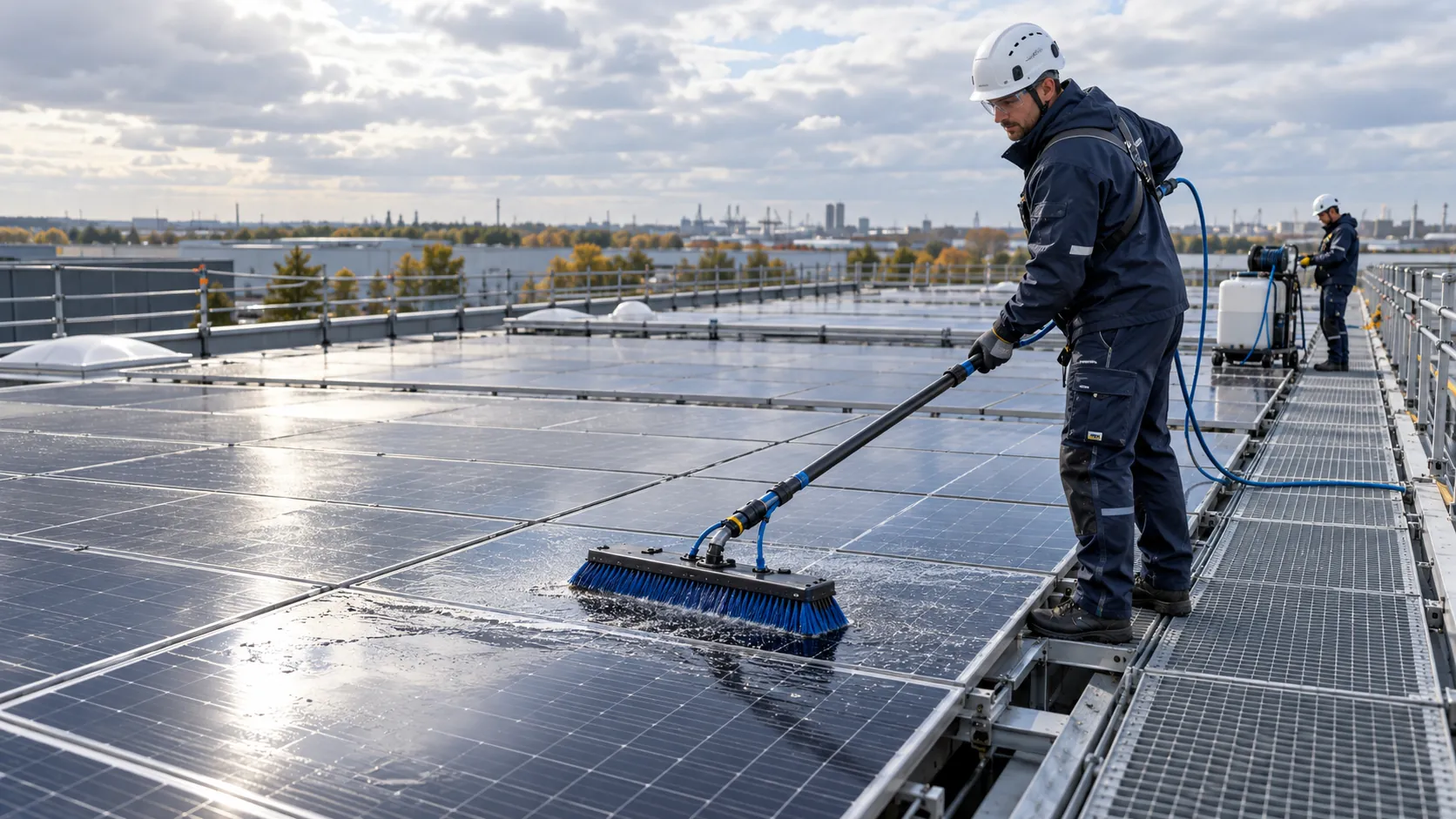
- Modules are not load-bearing surfaces: point loading from stepping on them or from equipment set down can damage cells and laminate, often without any immediately visible consequence. Roofs are moreover not walkable everywhere – trapezoidal sheet, sandwich panels and above all skylights and continuous rooflights are typical fall-through points. Binding on member businesses are the basic duties of DGUV Vorschrift 1; the DGUV Regeln on fall protection additionally describe the state of the art but are not a legal norm. Fall protection and access equipment are therefore part of the service, not its preparation.
- The array remains energised
- A solar module cannot be switched off: as soon as light falls on the cells, voltage is present, even when the inverter is not feeding in. The DC side must therefore be treated as live; for the handling of electrical systems and equipment, DGUV Vorschrift 3 applies to member businesses. Practical consequences are distance from plug connectors, junction boxes and inverter areas, and more favourable working times under diffuse radiation. Electrical work is a licensed electrician's task and is not part of the cleaning service.
- Cleaning agents and water
- Module glass is coated; anti-reflective layers react sensitively to abrasive removal, to strongly alkaline or acidic agents and to hard water, whose residues dry as limescale marks. The tender should therefore state which water quality is used; low-limescale or demineralised water and soft brush technology are usual. The yardstick is set out in the module manufacturer's cleaning and maintenance instructions: these are manufacturer specifications and not a legal norm, but they take effect through the purchase contract and the manufacturer's warranty terms. Anyone who deviates from them risks claims under that agreement – irrespective of how the result looks.
- Standards and their scope
- DIN VDE 0100-712 and DIN EN 62446 concern the installation and testing of photovoltaic systems. Both are private standards and not legal norms; they become binding only through contract, legal reference or presumption effect. Whether and to what extent they are relevant to a cleaning service has to be checked in the full text – professional review of the standard in its full text is required. Electrical testing is not part of the service here.
- Insurance
- System and building insurance policies often contain requirements on maintenance, documentation and the handling of the array. These requirements are not a legal norm; they take effect through the insurance contract. Whether a record suffices in the event of a loss is decided by the contract and the individual case – no statement about the scope of cover is made here. Before the work, clarify whether the array has to be in a particular state during it.
- Economic viability is a property question
- Whether and to what extent cleaning pays off depends on the type of soiling, the rate of deposition, roof pitch, row spacing, how the electricity generated is used, the size of the array and its age. Dust films behave differently from sticky soot or grease layers, bird droppings or agricultural dusts. These factors are recorded during the survey; no reliable statement about the expected yield is connected with this and none is made.
The rulebooks named here describe requirements for how the work is carried out – they are not a certification held by BREREI. VDI and DIN normative texts are chargeable and were not available in full; where a statement touches the normative detail, this is noted in place.