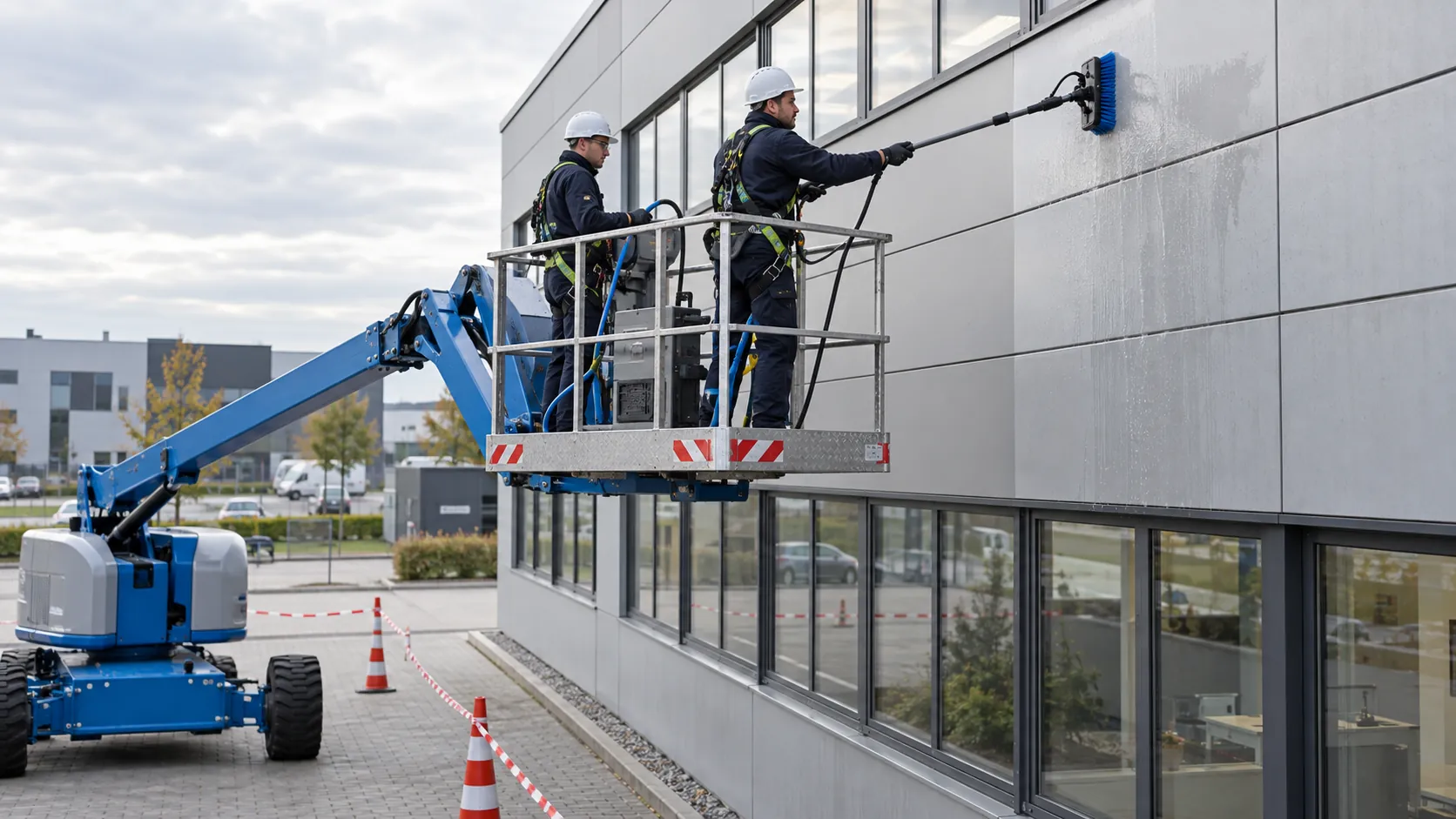
Cleaning a metal facade with a brush from an aerial work platform, with the work area cordoned off

Façade cleaning in Bremen: the finding sets the method – not the pressure

It is not pressure that decides, but the building material: an external thermal insulation composite system (ETICS) carries a pressure-sensitive render top coat, and a water-repellent treatment that seals off moisture transport is worse than none.

Discuss your façade

Category
Glass and facade cleaning
Reachable
Mo–Fr 07:30–17:30 Uhr
Site visit
Free of charge, on site

In short

Façade cleaning removes growth, soot, efflorescence and deposits from the building envelope; the permissible method depends on the material. An external thermal insulation composite system (ETICS) carries a pressure-sensitive render coat, calcareous natural stone tolerates no acid, aluminium no aggressive alkalis. A water-repellent treatment must stay water-repellent and vapour-permeable, or moisture accumulates in the component. A chalked metal façade is not dirty but weathered.

Problem und Lösung

The challenge

The façade is the only part of the building that everyone sees, including those who never go inside. The pressure to act is therefore high, while technical knowledge on the client's side is usually limited – and that is exactly where the risk lies. Four constellations almost always occur: the finding is visible, the cause is not; green or red growth on an insulated façade is perceived as dirt and equated with cleaning, although there is often a moisture problem behind it that returns after the cleaning. A paint finish is considered although cleaning would be enough, or the other way round. Someone offers to work with high pressure, which on an external thermal insulation composite system (ETICS) can permanently destroy the render top coat without the damage becoming visible at once. And nobody has thought about permits, waste water and a standing area; these organisational requirements are the most common reason for a date being postponed.

Our solution

The sequence follows a fixed logic, and the most important step is the first. The façade diagnosis determines the building material, the layer build-up, the finding and the cause, and in doing so separates soiling from weathering; that distinction decides whether cleaning is the right answer at all. The method then follows the material and the accessibility, and the decisive figure is not the pressure but the combination of dwell time, temperature, chemistry and jet guidance. A test area is created before the large surface is tackled, and the work is done in sections. Organisation, safeguarding and handling the run-off water belong in the order, not in the follow-up.

Scope of service

  • The subject of the contract is the property-specific schedule of services, which names the building materials, the area sections and the method for each.
  • Façade diagnosis: determination of the building material, the layer build-up, the finding and the cause. This is where it is decided whether soiling or weathering is present.
  • Clinker and brick masonry: soaking and washing off with a fan jet at moderate pressure; soot, moss, lichen and salt efflorescence sit in the joints and pores.
  • Render and external thermal insulation composite systems: low pressure with a soaking phase, because the render top coat can take little mechanical load. Where a biocide is needed, only products authorised for the intended use come into question.
  • Natural stone: the method depends on the type of stone. Calcareous varieties such as marble and travertine must not be treated with acid.
  • Aluminium and metal composite panels: pH-neutral, non-abrasive cleaning, because alkaline cleaners attack the oxide layer.
  • Organisation and protection: access technology according to height and reachability, standing area, safeguarding of the area below the work point, protection of planting and adjacent surfaces, and the handling of run-off water.
  • A test area before the large surface; the work is done in sections so that the finding can be assessed in advance.
  • Follow-up treatment as a separate item: a water-repellent treatment or other surface protection is only put out to tender after the material decision, with manufacturer information on the substrate and on diffusion behaviour. At the end comes the joint acceptance.
  • Scope boundary: glass surfaces and mullion-and-transom constructions are a service of their own with their own damage logic, even though both jobs are often ordered in one go. Traffic areas, courtyards and parking spaces are not part of the building envelope and are a service of their own.
  • Hauswand and Hausfassade mean the same building element. The boundary with glass cleaning: facade cleaning covers the opaque envelope — clinker, render, external insulation systems, metal and fair-faced concrete — while glass cleaning covers the glazing together with its frames and rebates. Where an external wall contains glazed areas, the surface decides which service applies, not the building.

Typical subservices

  • Clinker and brick façades
  • Rendered façades and external thermal insulation composite systems
  • Natural stone façades
  • Metal, trapezoidal sheet and composite panel façades
  • Plinth and splash-water zones
  • Façade drainage as part of bundled external works

Suitable for

  • Commercial property and office buildings – the façade is part of the property value and an argument in letting.
  • Residential complexes and housing companies – the most common trigger is the meeting of the owners' association; decision-making paths are longer and the demands on documentation higher.
  • Industrial and logistics halls – large continuous surfaces in trapezoidal sheet and composite panels, often with dust and soot loading rather than growth.
  • Clinker brick buildings in the existing stock – typical of commercial and administrative buildings in northern Germany; joint proportion and salt efflorescence dominate the topic here.
  • Insulated existing façades – the technically most demanding case, because the render top coat is pressure-sensitive and the growth is often moisture-related.
  • Listed and heritage-worthy buildings – their own method and approval logic, with coordination and a test area.

Your advantages

Tailored to this service – aligned with site and industry.

  • Material before pressure

    The render top coat of an external thermal insulation composite system is a thin layer over a soft insulating core. A hard jet wears it away; this often only becomes visible in raking light or after the next frost.

  • Soiling or weathering

    On coated metal façades the difference shows as chalking: the surface is not dirty, the coating has broken down. Cleaning only helps in part there, because the material itself is damaged.

  • Vapour-permeable or not at all

    A hydrophobising follow-up treatment is meant to repel water and still let the material breathe. If it seals off moisture transport, moisture can remain in the component – with consequences for growth, frost resistance and insulating performance.

Process

How your project runs

  1. 1

    Façade diagnosis

    The building material, the layer build-up, the finding and its cause are determined. This is where it is decided whether this is soiling or weathering and loss of substance.

  2. 2

    Method according to material and accessibility

    The decisive figure is not the pressure but the combination of dwell time, temperature, chemistry and jet guidance – on pressure-sensitive substrates with a soaking phase.

  3. 3

    Organisation and protection

    Access technology, standing area, safeguarding of the area below the work point, protection of planting and adjacent surfaces as well as the handling of run-off water are clarified in advance.

  4. 4

    Test area and cleaning in sections

    The method is checked on a test area before the large surface is treated. The work is done section by section so that access and operations stay plannable.

  5. 5

    Follow-up treatment and acceptance

    A water-repellent treatment or other surface protection only follows if it has been agreed and the system suits the substrate. The finish is the joint acceptance on the component.

Methods and equipment

  • Pressure-sensitive substrates: leave to soak and wash off with a moderate fan jet. On a render or insulation system, more pressure is the wrong direction, because the render top coat is worn away.
  • Clinker and brick masonry: soaking and washing off with a fan jet at moderate pressure. Soot, moss, lichen and salt efflorescence sit in joints and pores and need dwell time rather than pressure.
  • Natural stone: the method follows the type of stone. Calcareous varieties must not be treated with acid, because the acid attacks the stone surface.
  • Metal and composite panels: pH-neutral, non-abrasive cleaning. Alkaline cleaners attack the oxide layer, abrasive agents destroy the remaining coating.
  • Cleaners containing biocides only come into question if the product is authorised or registered for the intended use; what counts is the product labelling and the safety data sheet. A biocide also removes the growth, not its cause.
  • Follow-up treatment: a hydrophobising treatment is meant to repel water and still let the material breathe. Silane- and siloxane-based systems typically remain vapour-permeable, film-forming systems seal the surface more strongly.

Technical and legal framework

This service sits within a framework of statutory duties, technical rulebooks and operational practice. The distinction matters because it determines who is responsible for what.

Building physics: a water-repellent treatment is a material decision
If moisture transport is enclosed by a follow-up treatment, moisture can remain in the component – with consequences for growth, frost resistance and insulating performance. On an external thermal insulation composite system the difference is considerable. A water-repellent treatment with the wrong system is therefore worse than none. The question is not “to treat or not to treat” but “which system does this substrate tolerate”; the system, the substrate requirements and the diffusion behaviour belong in the tender together with manufacturer information.
Pressure-sensitive surfaces
The render top coat of an external thermal insulation composite system is a thin layer over a soft insulating core that can take little mechanical load. A hard jet wears it away, and the damage often only becomes visible later: in raking light, after the next frost, or when water penetrates the exposed spot. On such substrates the route is therefore not more pressure but more time.
Water law: the run-off water is part of the service
The Federal Water Act is legally binding and requires water bodies to be protected from adverse change; discharging cleaning water is therefore not a matter of choice. If cleaning or impregnating agents are stored, decanted or handled, the Ordinance on Installations for Handling Substances Hazardous to Water may additionally apply. In practice, clients and municipalities often require containment and filtration for contaminated waste water. What is binding is the assessment of the individual case with the competent authority or the sewer network operator – neither a blanket obligation nor a blanket prohibition.
Biocides are EU law, not an industry habit
Algal and fungal growth is frequently treated in the industry with cleaners containing biocides. The Biocidal Products Regulation of the European Union is binding EU law: such products may only be used if they are authorised or registered for the intended use; what counts is the information in the product labelling and the safety data sheet. Methodically, it remains the case that a biocide removes the growth, not its cause. Where growth is moisture-related, it returns.
Work at height and in public traffic space
The Industrial Safety Ordinance is legally binding and requires a risk assessment as well as the selection of suitable work equipment; for member businesses of the employers' liability insurance association, DGUV Vorschrift 1 is binding. How the qualification of the height workers is evidenced and whether the work is done with the contractor's own staff or through a subcontractor therefore belongs in the description of the order. If the work equipment stands in public traffic space, a no-stopping zone and possibly a special-use permit are added: who applies and with what lead time has to be recorded in advance.
Listed-building protection applies only where it actually bites
For listed buildings the monument protection law of the respective federal state applies, in Bremen the Bremisches Denkmalschutzgesetz; it is legally binding, but not the normal case for every façade. It can give rise to permit requirements, specifications on the method and the choice of material, and the requirement to first create a test area and agree it with the monument authority. Whether and to what extent this applies depends on the property and the individual case and has to be clarified with the competent authority before any commitment. In planning, this lead time belongs in the schedule, not in the follow-up.

The rulebooks named here describe requirements for how the work is carried out – they are not a certification held by BREREI. VDI and DIN normative texts are chargeable and were not available in full; where a statement touches the normative detail, this is noted in place.
What determines the interval

  • Exposure: position relative to water bodies, prevailing wind direction, driving rain loading and shading. A north-west façade near water ages differently from a sheltered inner courtyard façade of the same building.
  • Conditions that favour growth: insulation, trees close to the building, permanently damp areas and splash-water zones. Where these conditions persist, the frequency is symptom management and not a solution.
  • Building material and surface: clinker brick with a high joint proportion, a thin render top coat and a coated metal panel behave completely differently.
  • Emission environment: traffic loading, industrial exhaust gases, construction activity and proximity to rail or port.
  • Representational demand: a façade with public traffic and an interest in letting it demands more than a rear elevation with no amenity value.
  • Regulatory requirements: on listed buildings, conditions or coordination with the monument authority can set the pace.
  • Accessibility and organisation: scaffolding or a platform cause considerable effort. Façade work is therefore often bundled – cleaning, windows, gutters and smaller repairs in one go.

What determines the effort and the quotation

  • Façade area and articulation: interrupted surfaces with many edges, recesses and inner courtyards take more work than one continuous wall.
  • Building material and surface condition: they determine the method, chemistry and pressure and therefore the time required. Component documents – material, layer build-up, earlier treatments and, on insulated façades, the system – shorten the diagnosis considerably.
  • Type and extent of the finding: growth, soot, efflorescence and chalking differ considerably in effort. Where growth is moisture-related, the analysis of causes is added as an item of its own.
  • Access technology: set-up time, standing area, safeguarding and permits are often the largest single item. An aerial work platform needs load-bearing, clear ground close to the work; occupied parking spaces, driveways, lawns and fire service access routes have to be clarified in advance.
  • Public traffic space: if the work equipment stands in the street or on the pavement, a no-stopping zone and possibly a special-use permit are added. Who applies and with what lead time belongs in the order.
  • Protection and safeguarding effort: planting, vehicles, bicycle stands, exterior lighting and adjacent surfaces that must not be wetted. Close to water bodies, the handling of the run-off water is added.
  • Follow-up treatment: a water-repellent treatment or other surface protection increases the effort and the share of material. Whether it is ordered and with which system has to be decided in advance; documents on substrate requirements and diffusion behaviour belong in the tender.
  • Time window, season and coordination: the vegetation period, the weather and conditions for protecting planting determine the possible date. On listed buildings and unclear substrates a test area and coordination are added; on residential complexes, informing tenants and neighbours.

Applicable standards and regulations

  • Federal Water Act (Wasserhaushaltsgesetz, WHG)
  • Ordinance on Installations for Handling Substances Hazardous to Water (AwSV)
  • Biocidal Products Regulation (EU) 528/2012
  • Bremisches Denkmalschutzgesetz (monument protection act of the state of Bremen)
  • Industrial Safety Ordinance (BetrSichV)
  • § 823 BGB – duty of care towards persons on the premises
  • DGUV Vorschrift 1 – accident prevention regulation, binding on member businesses
  • Manufacturer information on cleaning, hydrophobising and coating systems

These references describe the requirements the work is performed against. They are not a certification, inspection or approval held by BREREI.

Frequently asked questions about this service

Short answers to help you assess whether this service fits your site.

Does high pressure destroy a rendered or insulated façade?

It can. The render top coat of an external thermal insulation composite system is a thin layer over a soft insulating core and can take little mechanical load. A hard jet wears it away, and the damage often only becomes visible later – in raking light, after the next frost or when water penetrates the exposed spot. On sensitive substrates the route is therefore not more pressure but more time: leave to soak and wash off with a moderate fan jet. The material diagnosis at the start decides which route is permissible.

How can you tell whether a façade is only dirty or already weathered?

A practical guide: soiling can be washed off and returns evenly, weathering changes the surface itself. On coated metal façades this shows as chalking – the surface is not dirty, the coating has broken down; it feels powdery and leaves marks. Cleaning only helps in part here, because the material itself is damaged. On render, weathering shows as sanding off, cracks or defects. That distinction determines whether cleaning is enough or repair work is needed.

Does façade cleaning require a permit?

That depends on the property and on the access technology. For listed buildings, state law applies – in Bremen the Bremisches Denkmalschutzgesetz – which can contain permit and procedural requirements; a test area is often required. Irrespective of monument protection, a permit becomes relevant when work equipment stands in public traffic space: then a no-stopping zone and possibly a special-use permit are usually needed. Who submits the application should be recorded in the order; experience shows that the lead time is the critical part.

What applies to the run-off washing water and to algaecides?

Neither is a matter of choice in legal terms. The Federal Water Act obliges you to protect water bodies; if cleaning or impregnating agents are stored or handled, the Ordinance on Installations for Handling Substances Hazardous to Water may additionally apply. In practice, clients and municipalities often require containment and filtration for contaminated waste water before it reaches the drainage system; what is always binding is the assessment of the individual case with the competent body. For algaecides and fungicides: biocidal products may only be used if they are authorised or registered for that intended use under the Biocidal Products Regulation.

How long does the façade stay clean afterwards?

No reliable figure can be promised in good faith, because it depends on exposure: position relative to water bodies, prevailing wind direction, shading, trees, insulation and traffic loading. Two façades of the same building can behave completely differently. What makes more technical sense than a blanket period is therefore a property finding with a recommendation per façade side – and the insight that where growth is moisture-related, the cause decides the outcome, not the cleaning method.

Does façade cleaning replace repainting?

No, those are two different things. Façade cleaning is maintenance, not repair: it removes deposits and growth and restores the appearance as far as it was soiling. It does not restore a weathered paint finish, a render that has sanded off or a coating that has flaked away – that requires repair work. The reverse also holds: painting over a dirty façade is usually the more expensive wrong decision, because the substrate has to be prepared first. The question “clean or paint?” is therefore answered on the component, not on a photo.

Request façade cleaning

The first step is not work equipment but a look at the finding and the building material. What helps us give a reliable assessment: the age and construction of the building, existing documents on the façade, the listed status, an available standing area and the question whether further external work should be bundled in one go.

Prefer to talk?

0421 87757597

Mon–Fri, 07:30–17:30 – we are happy to call you back.

Request a quote in two minutes

Service, property and contact details – that is all we need.

Or use the full contact form