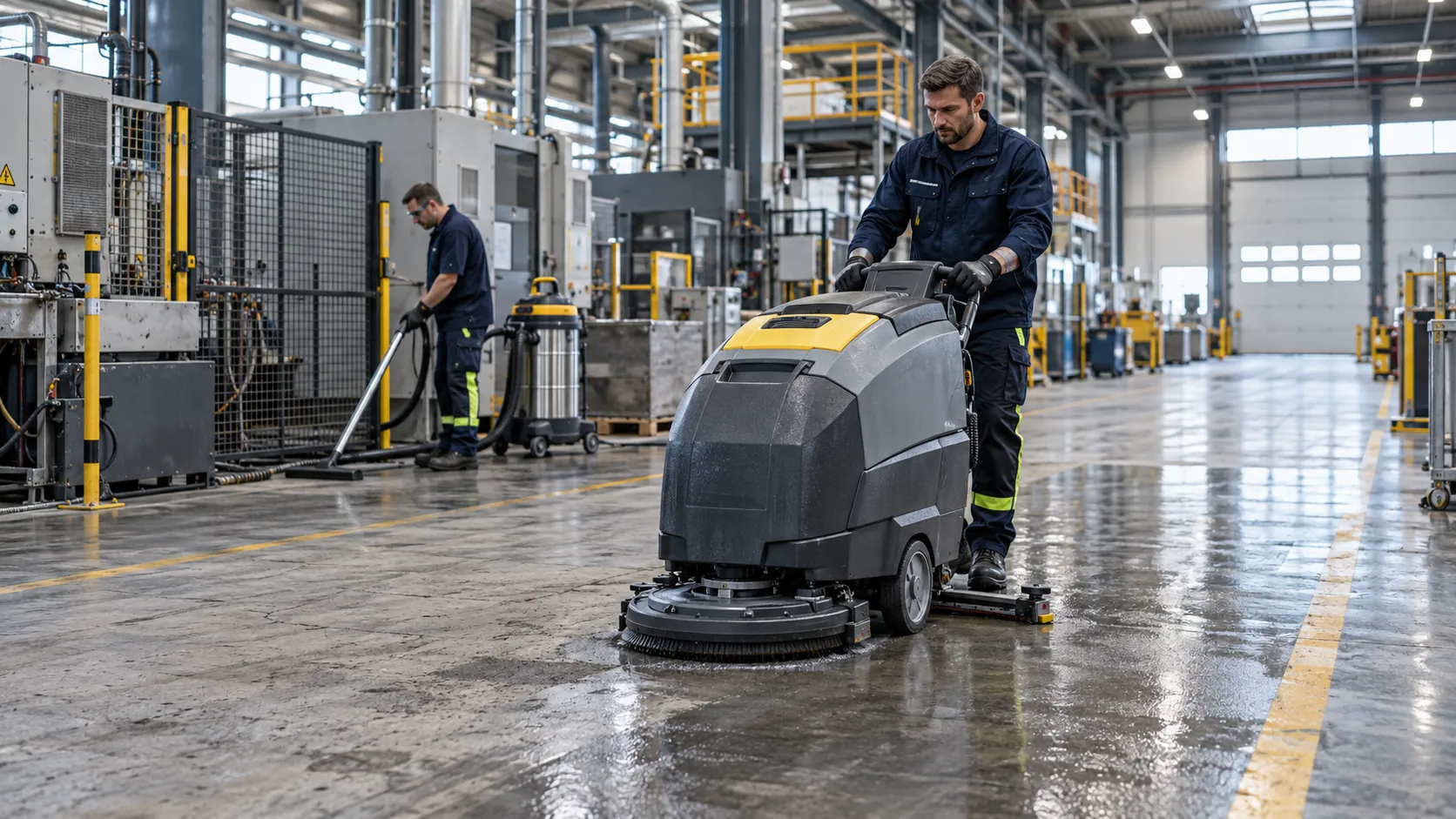
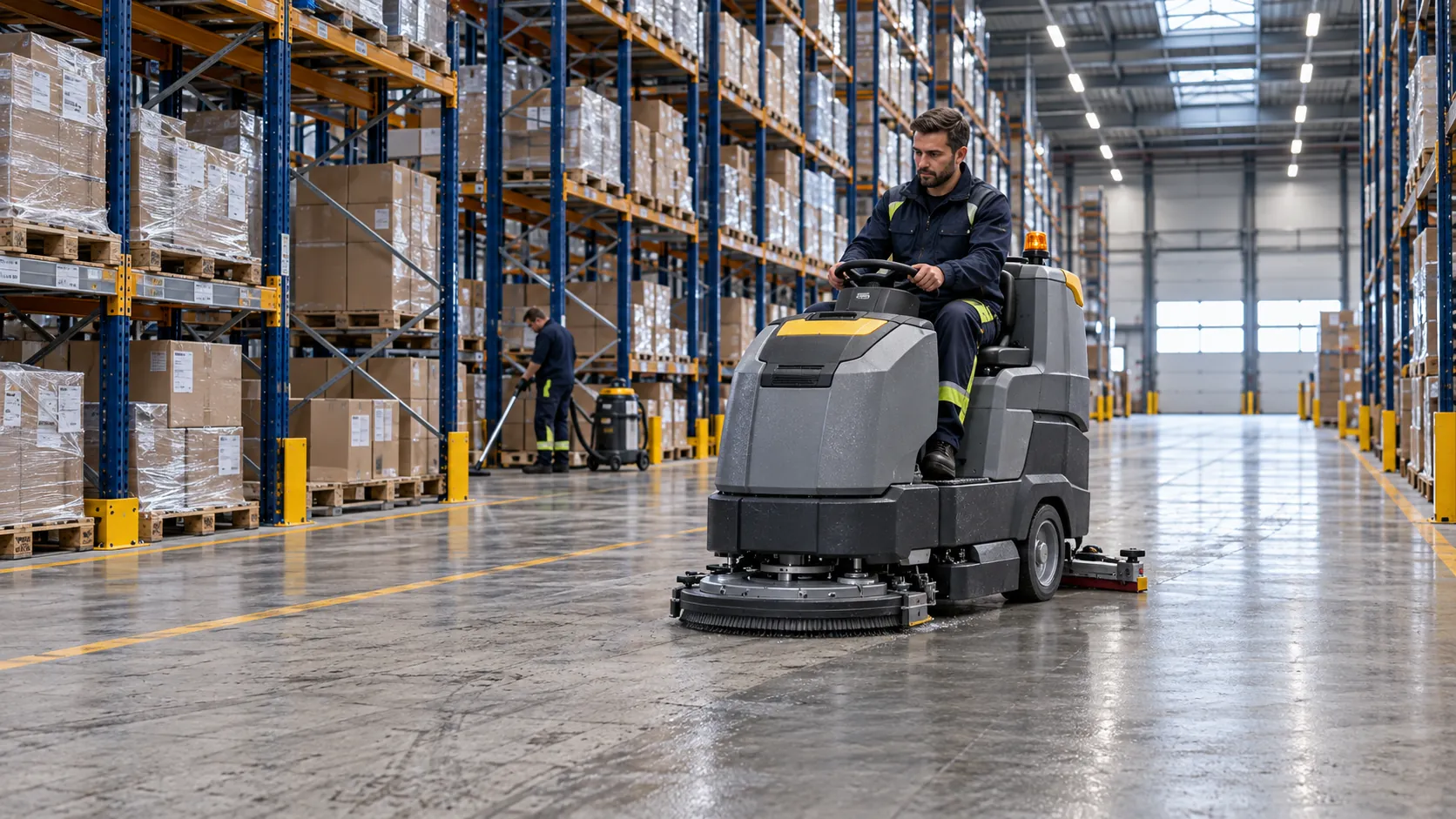
Ride-on scrubber-dryer cleaning the floor between high-bay racks in a warehouse

Warehouse cleaning in Bremen: floors, racking, beams and fire protection areas

Each of the three zones has its own soiling, its own access and its own cleaning interval. The bottleneck is less the area than its segmentation.

Discuss your hall

Category
Industrial cleaning
Reachable
Mo–Fr 07:30–17:30 Uhr
Site visit
Free of charge, on site

In short

Warehouse cleaning has three zones: floors and driveways, racking and logistics surfaces, and the high-level area with beams, lighting and fire protection installations. Each zone has its own soiling, access and cleaning interval. The hall is split into sections that are closed off individually and released only once dry. Work proceeds from top to bottom, so dust does not fall on cleaned surfaces.

Problem und Lösung

The challenge

The trigger is rarely “the hall is dirty”. Usually it is a fine layer of dust on the goods that customers complain about and that shows up in audits; oily wheel tracks on which forklifts slip and the markings can hardly be seen; dust deposits on sprinkler heads and beams that the insurer objects to; or the question whether the hall can be closed for cleaning at all. The brief is therefore not “sweep the hall” but: divide a large area so that it can be worked section by section without breaking the flow of goods – and without altering fire protection installations.

Our solution

In the site visit the floor, the racking surfaces and the high-level area are recorded separately and the hall is divided into sections that can be closed off and released independently – usually racking aisles or fire compartments. The sequence is aligned with order waves, the shift plan and vehicle traffic, sensitive goods are covered or cleared, and dust-intensive work is discussed in advance with the fire alarm monitoring centre. Cleaning runs from top to bottom: first the high-level area, then racking and surfaces, and the floor last. A section is only handed back once it is dry and drivable again; the documentation records each section with date and condition.

Scope of service

  • Dry floor cleaning: sweeping and vacuuming of aisles, loading zones and picking areas, including cardboard dust, film remnants, grit and sand.
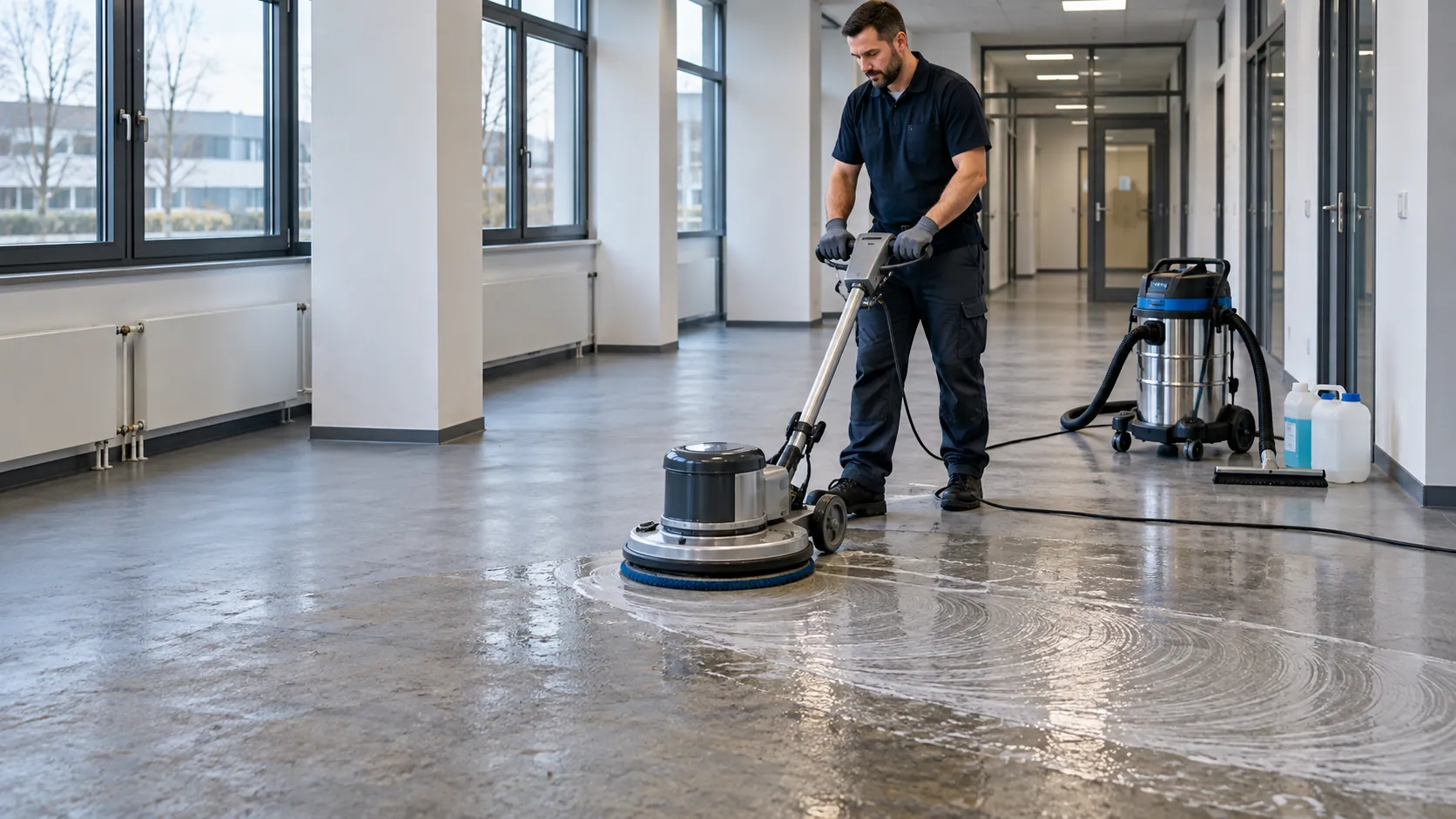
  • Wet floor cleaning: machine scrubbing and suction with immediate extraction of the waste water, where wet cleaning is possible and the waste water route has been clarified.
  • Removal of tyre abrasion: removal of the black rubber marks left by industrial trucks in the wheel tracks. Compatibility with the existing floor coating has to be clarified in advance.
  • High-level area: extractive dust removal from beams, cable trays and pipework. How high the work is carried out and with which technology is information that should be requested in the tender.
  • Fire protection installations are not a cleaning surface but a boundary: sprinkler heads, detectors and fire protection devices are not moved, not brushed, not covered and not exposed to pressure. What is permissible in their vicinity follows from the insurer guidelines and the insurance contract.
  • Racking, columns, doors and dock bumpers: racking uprights, sectional doors, dock bumpers and impact protection.
  • Lighting and lighting runs: dust removal from luminaires and continuous lighting runs to maintain the illuminance.
  • Disposal and the waste water route: collection, separation and documented handover of the residues and waste water produced – including the question which channels, shafts and separators may be used.
  • Scope boundary to industrial cleaning: in the hall, dust, abrasion and packaging residues dominate, in production it is oils, emulsions and process residues. Where both are in one building, the boundary expressly belongs in the quotation.

Typical subservices

  • Aisles, loading zones and picking areas
  • Dry and wet floor cleaning
  • Tyre abrasion in the wheel tracks
  • High-level area: beams, cable trays and pipework
  • Racking, columns, doors and dock bumpers
  • Lighting and lighting runs
  • Section record and release

Suitable for

  • Transhipment and distribution halls – wide aisles, loading zones, ramps, a high share of traffic and short cleaning windows.
  • High-bay warehouses – narrow aisles, racking levels right up to the roof, automated conveyor and shuttle systems.
  • Fulfilment and picking centres – many small parts, paper and cardboard dust, packaging residues, netting and conveyor technology.
  • Storage close to production – a mixed form of dust, packaging and process residues, where the boundary to industrial cleaning needs clarifying.
  • Workshop and service halls – a mixture of floor soiling, tool areas and the surroundings of vehicle lifts.
  • Chilled and frozen storage areas – their own requirements on technology, moisture and occupational health and safety.

Your advantages

Tailored to this service – aligned with site and industry.

  • The high-level area is fire protection

    Dust on beams and cable trays is fire load; dust on sprinkler heads and detectors touches the function of the installation itself. Which requirement follows from that is not in the law but in the insurer guideline and the insurance contract.

  • Dry first, then release

    A cleaned section is smoother during and immediately after the work than in its final state. It stays closed until it is dry and has grip again – traffic safety on the route depends on it.

  • From top to bottom

    Anyone who starts at the bottom works twice. The order of high-level area, racking surfaces, floor is not a formality in warehouse cleaning but the decisive quality factor.

Process

How your project runs

  1. 1

    Site visit and division into zones

    Floor, racking surfaces and high-level area are recorded separately, heights and accessibility are captured, fire protection installations and luminaires are recorded.

  2. 2

    Fix the segmentation

    The hall is divided into sections that can be closed off and released independently – usually racking aisles or fire compartments.

  3. 3

    Align with operations

    Sequence according to order waves, shift plan and vehicle traffic; cover or clear sensitive goods, close off the area, discuss dust-intensive work with the fire alarm monitoring centre, and settle who closes a section and who releases it.

  4. 4

    Clean from top to bottom

    First the high-level area, then racking and surfaces, and the floor last – dry or wet per section, with immediate extraction of the waste water where wet cleaning is used.

  5. 5

    Release and documentation per section

    A visual check for dryness and drivability, then handover back to operations; a record with date and condition, so that evidence can be provided to an insurer or an audit.

Methods and equipment

  • Order from top to bottom: first beams, cable trays and lighting, then racking and columns, and the floor last.
  • Extraction instead of blowing off: compressed air only shifts dust, extractive methods take it up.
  • Dry or wet floor cleaning per section. With wet cleaning the waste water is extracted immediately so that it does not run into aisles and channels.
  • Segmentation instead of a full closure: the hall is divided into units that are closed, cleaned and released individually.
  • In the vicinity of fire protection installations the work is carried out at a distance, without moving, brushing, covering or pressurising the installation.
  • Tyre abrasion is not treated with abrasive pads or strong solvents as long as it has not been clarified whether the floor coating can take it.

Technical and legal framework

This service sits within a framework of statutory duties, technical rulebooks and operational practice. The distinction matters because it determines who is responsible for what.

Who carries the responsibility
The cleaning obligation falls on the operator: as owner under the duty of care towards persons on the premises, as employer under occupational health and safety law. The cleaning contract organises this obligation, it does not transfer it. The basis of the operator's duties is the Occupational Health and Safety Act and the Ordinance on Workplaces – binding law, not a recommendation.
VdS is not a law
Insurer guidelines on fire protection (VdS) are not a legal norm. They take effect through the insurance contract, which requires maintenance and servicing of the fire protection installations. Which guideline applies in an individual case follows from the contract and has to be clarified before the work. Technical review of the standard in its full text is required.
Slip resistance on traffic routes
For the condition of floors in workplaces, the workplace rule ASR A1.5 “Floors” is drawn on – not a legal norm, but with presumption effect within the framework of the Ordinance on Workplaces. During and immediately after cleaning a section is smoother than in its final state and therefore stays closed until it is dry and has grip again. Assessing slip resistance remains the operator's task.
Fire alarm system
Dust-intensive work at great height can set off a fire alarm system. What is usual is therefore an arrangement agreed in advance: informing the control centre or the security service, a limit on the time window and, where necessary, an agreed arrangement for the alarm transmission. Anyone who works without this agreement risks a fire service call-out and the subsequent discussion about the cost.
High-level access and work equipment
For work on beams, ceilings and luminaires, DGUV Vorschrift 1 applies as an accident prevention regulation binding on member businesses, supplemented by the DGUV Regeln on working on and with work equipment and ladders; these rules are not a legal norm but describe the recognised state of the art. The access route for a work platform is also a logistics topic in its own right – a platform in a picking aisle is itself an obstruction to traffic.
Waste water and separation
Wet scrubbing with suction produces waste water containing solids, sometimes with oil fractions from vehicle traffic. Where it may be discharged is decided by the on-site separation and the water law situation of the location. The Federal Water Act and the Ordinance on Installations for Handling Substances Hazardous to Water are binding law; this question has to be clarified before the work. Technical review of the standard in its full text is required.

The rulebooks named here describe requirements for how the work is carried out – they are not a certification held by BREREI. VDI and DIN normative texts are chargeable and were not available in full; where a statement touches the normative detail, this is noted in place.
What determines the interval

  • Dust ingress from outside: road dust, sand, grit in winter and proximity to bulk material or construction activity.
  • Traffic intensity and type of tyres: more vehicle movements mean more abrasion and faster re-soiling of the aisles.
  • Goods handled: cardboard produces paper dust, building materials mineral dust, food or hygiene products demand different standards.
  • Height and construction of the hall: higher halls with exposed beams and cable trays visibly collect more dust than clad structures.
  • Door opening behaviour: doors that are frequently opened bring in more dirt than closed circulation areas.
  • Third-party requirements: insurance conditions, customer requirements in contract logistics and hygiene specifications for sensitive goods.
  • Regularity of floor care: where dry sweeping and vacuuming are done continuously, the effort for wet cleaning stays lower.

What determines the effort and the quotation

  • Segmentation: many small sections, each with its own closure and release, take more time than one continuous area
  • Accessibility: aisles between racking, areas under conveyor technology and high racking density reduce the area performance considerably
  • High-level access: work on beams, cable trays and ceilings requires platforms, barriers and additional safeguarding
  • Type of soiling: ingrained tyre abrasion and mineral deposits take more work than loose dust
  • Number of deployments: one block is cheaper than many short deployments of the same total scope, because set-up and travel effort arises per deployment
  • Waste water route and disposal: collection, separation and handover including the required evidence
  • Depth of documentation: section records, photos and condition reports are effort and should be visible in the quotation
  • Your preparation: segmentation plan, release arrangements, coordination on the fire alarm system, information on the waste water route, substrate and coating as well as the height data from the hall plan – missing information becomes visible in the quotation as a risk item

Applicable standards and regulations

  • Occupational Health and Safety Act and Ordinance on Workplaces – legally binding
  • ASR A1.5 “Floors” – workplace rule, not a legal norm; presumption effect under the ArbStättV
  • DGUV Vorschrift 1 – accident prevention regulation, binding on member businesses
  • DGUV Regel 108-007 – storage installations and equipment; DGUV Regel, not a legal norm, scope to be checked in the full text
  • DGUV Regeln on ladders and work platforms – DGUV Regel, not a legal norm; recognised state of the art
  • Insurer guidelines on fire protection (VdS) – insurer guideline, not a legal norm; takes effect through the insurance contract
  • WHG / AwSV – legally binding; handling of waste water and its discharge
  • Industrial Safety Ordinance – legally binding; operation of the machines and work platforms used

These references describe the requirements the work is performed against. They are not a certification, inspection or approval held by BREREI.

Frequently asked questions about this service

Short answers to help you assess whether this service fits your site.

Does the hall have to be closed completely for the cleaning?

As a rule, no. What is usual is closing individual aisles or fire compartments, which are released again after cleaning. The precondition is that traffic does not have to pass through the closed section and that the diversion is settled with operations; where escape and rescue routes are affected, an agreed arrangement is needed. What you should set out in the tender: which sections may be closed when, which machine and extraction technology is intended for it, and up to what working height the work should be done.

How is dust prevented from falling on the goods?

The work area is closed off and the goods underneath are covered or cleared. Work is done from top to bottom and with extraction rather than compressed air, because compressed air only shifts the dust. The decisive measure is the sequence: first the high-level area, then the racking, then the floor – otherwise the dust that is removed falls onto surfaces that have just been finished.

Who may work in the area of fire protection installations?

Sprinkler heads and detectors are installations on which work is only carried out with the approval of the operator and the insurer. What is permissible is dust removal in the vicinity, without moving, bending, brushing or covering the installation. Which procedure applies follows from the insurer guidelines and the insurance contract – an insurer guideline is not a legal norm, but it takes effect through the contract. Clarify in advance which requirement your insurer sets and who grants the approval.

What happens to the waste water?

It is taken up by the machines, separated as far as possible and disposed of through the on-site separation or an external receiving point. Whether discharge into the site drainage is permissible depends on the design of the separator and on the water law situation of the location. Water law and the Ordinance on Installations for Handling Substances Hazardous to Water are binding law; this question has to be clarified before the work.

How often does a hall have to be cleaned?

There is no fixed interval. It follows from dust ingress, traffic intensity, the goods handled and the requirements of third parties. Short intervals are usual for aisles and loading zones and considerably longer ones for the high-level area, whose interval follows the amount of dust and any conditions imposed rather than a fixed calendar. What makes sense is a rhythm that does not end in a rush before an audit or an inspection.

How is the cleaning evidenced?

Documentation by section with date and condition, supplemented by photos, is sensible and usual. It is the basis for discussions with the insurer, for customer requirements in contract logistics and for your own maintenance planning. The extent of the documentation is fixed in the quotation and should be named in the tender already – a blanket “record” leaves open what can be evidenced in a dispute.

Request warehouse cleaning

For a reliable quotation we need the hall plan and the subdivision of areas, the time windows in which sections can be closed off, and information on fire protection installations, floor coating and the waste water route. The quotation is structured by floor, racking and high-level area and names the segmentation, preparation, disposal and documentation.

Prefer to talk?

0421 87757597

Mon–Fri, 07:30–17:30 – we are happy to call you back.

Request a quote in two minutes

Service, property and contact details – that is all we need.

Or use the full contact form