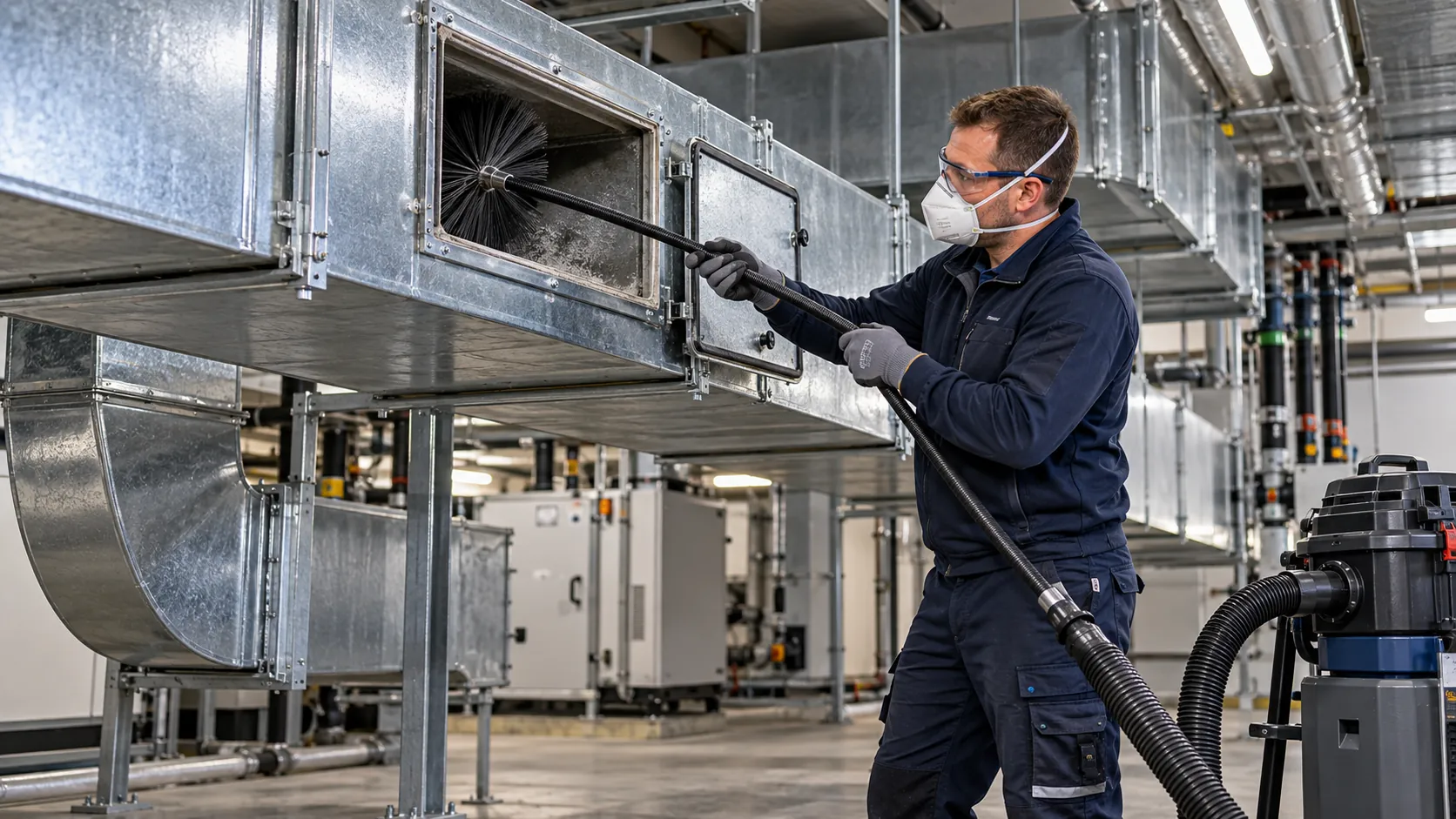
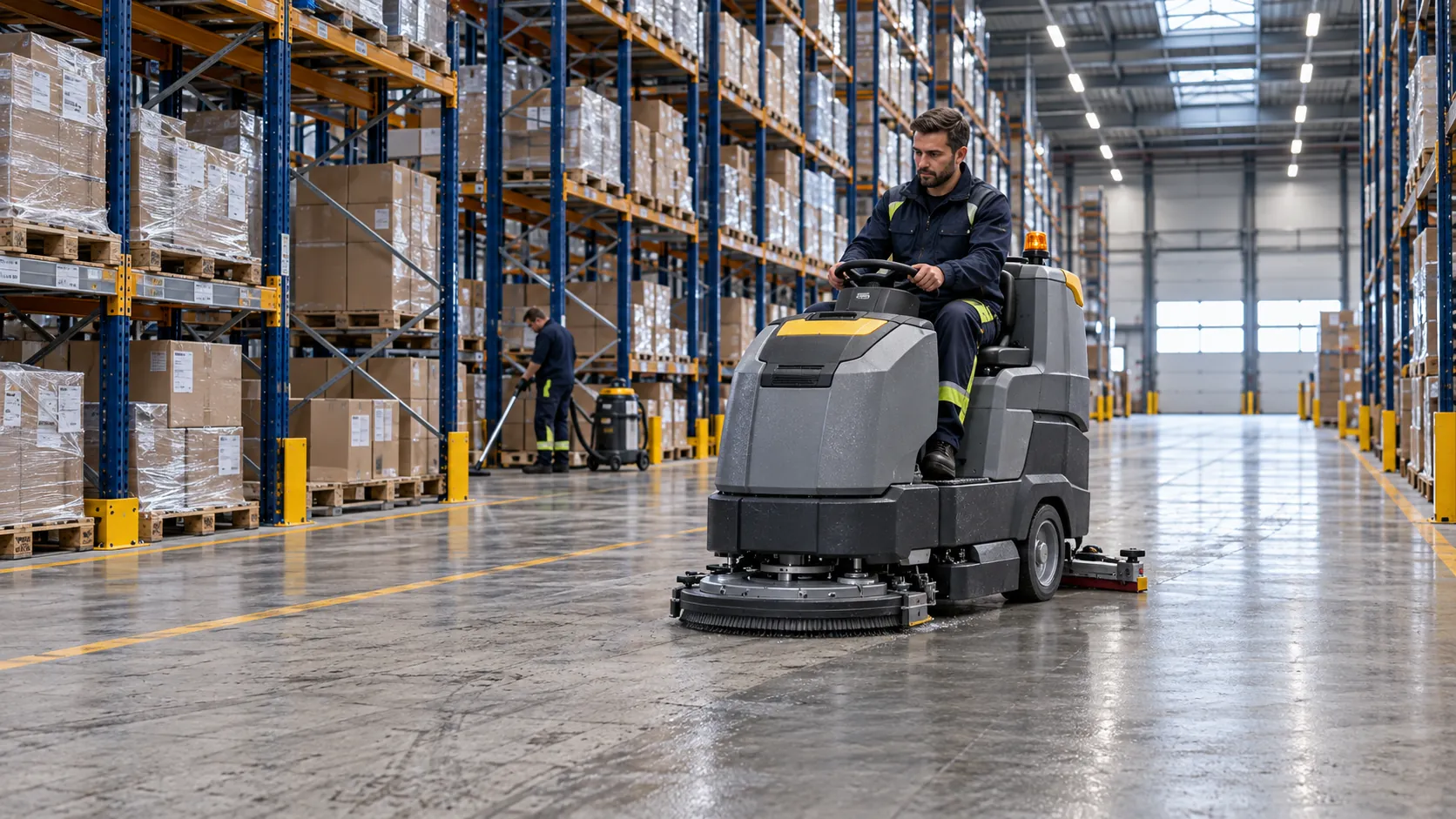
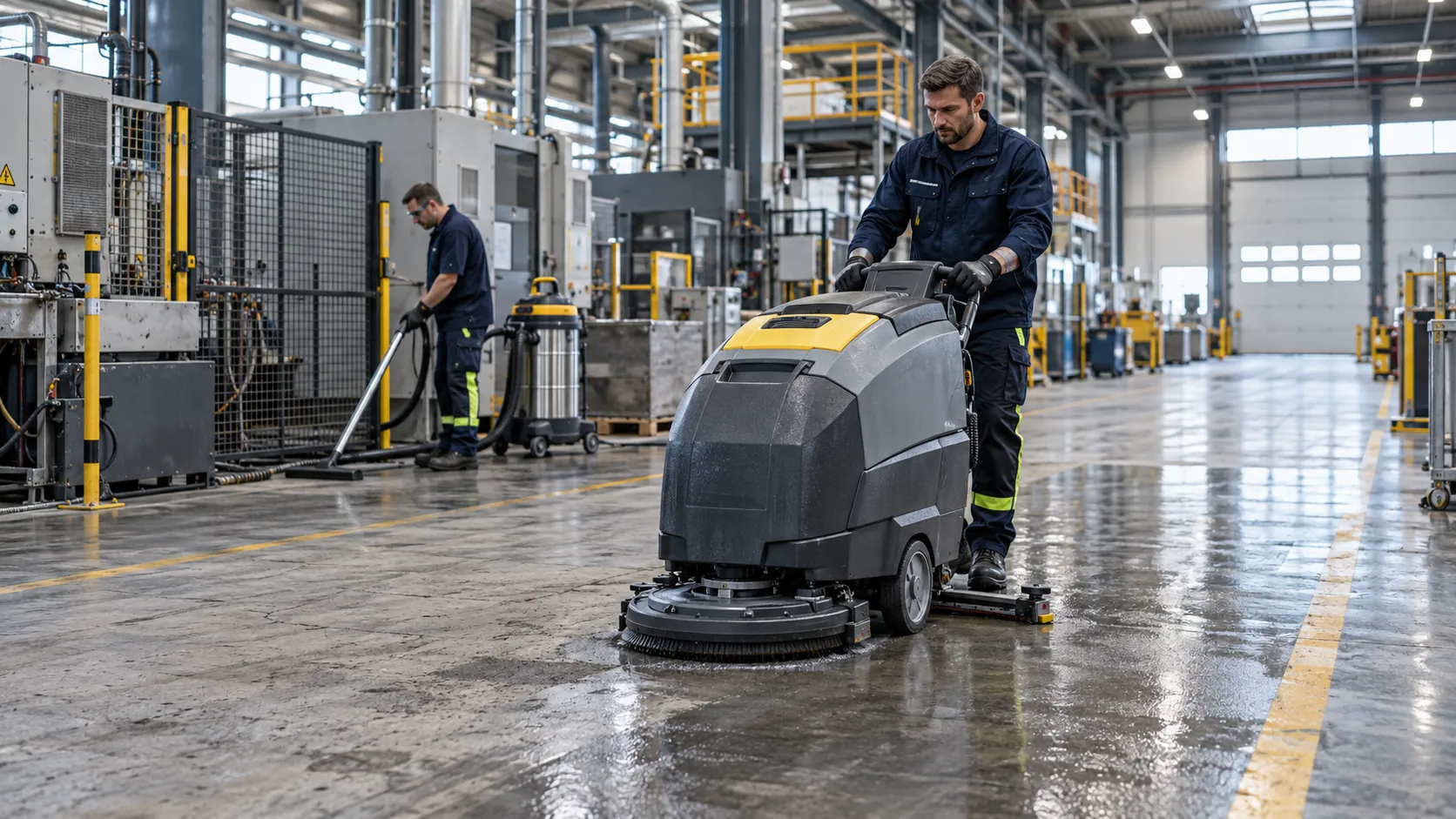
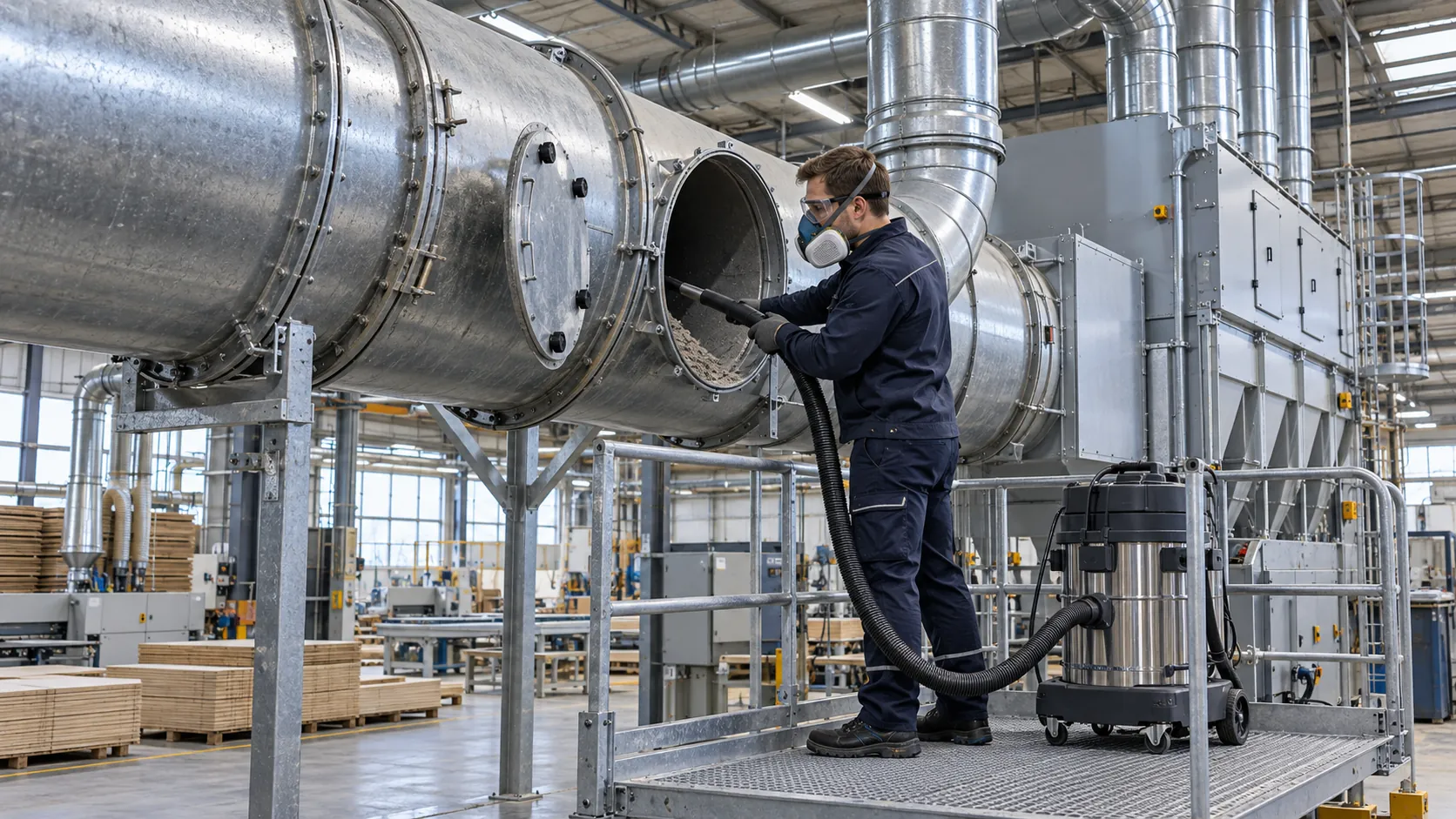
Vacuuming deposits out of an opened extraction duct with an industrial vacuum and respiratory protection

Cleaning industrial extraction systems: dust, ignition protection and effectiveness testing

Whether, when and with what technology cleaning may be carried out is set by the operator's explosion protection. These specifications are the working basis, not the question asked afterwards.

Discuss the hazard situation

Category
Industrial cleaning
Reachable
Mo–Fr 07:30–17:30 Uhr
Site visit
Free of charge, on site

In short

With industrial extraction systems, cleaning is itself a safety-relevant operation: when units are opened and dust is extracted, dust clouds and ignition sources can come together. The operator therefore defines the zones and the explosion protection document, and cleaning is carried out with suitable, potential-equalising technology. It replaces neither the inspection of the system nor the effectiveness testing of the capture at the workplace.

Problem und Lösung

The challenge

An extraction system is not an end in itself in production. It protects employees from dust, smoke and mist and keeps the machine running – both only as long as the system works in air-handling terms. If deposits grow on pipe walls, in the housing, on the fan impeller and in the filter plenums, the differential pressure rises, the capture at the point of origin declines, and the fan works against a higher resistance. The second part of the problem is less visible: combustible dusts that settle in ducts and assemblies are a hazard in their own right. Deposits on horizontal pipe runs, at bends, on hoppers, on filter housings and on high-level surfaces are the starting point for subsequent events – they act as a secondary dust source as soon as re-entrained dust forms a second cloud. Cleaning such systems is therefore not a caretaking job but work requiring a risk assessment.

Our solution

The procedure follows one principle: first the hazard is clarified, then work begins. At the start stand the explosion protection document, the zone plan, the risk assessment, the system diagram and information on which dusts actually arise. From that the working method is defined: which sections are opened when, which technology is used, which areas are cleared during the work and who releases the system. Cleaning is carried out with low-spark tools and suitable extraction technology, with potential equalisation of all conductive parts and without dry sweeping – in the direction of flow, where required under controlled negative pressure. Filter stages are replaced according to condition and differential pressure and installed in such a way that no bypass to the clean-gas side arises; the fan impeller and housing are cleaned and inspected for deposits and imbalance. Then reclosure, release by the client and a report with the sections worked on, findings, material quantities and anomalies.

Scope of service

  • Preliminary discussion and document review: comparison with the explosion protection document, zone plan, risk assessment and system documentation. If these details are missing, that is not a formal defect but a reason not to begin the work.
  • Shutdown and release: safe shutdown, release by the client and securing against restart, and for central systems additionally coordination with all connected workstations.
  • Opening the system: inspection covers, filter housings, hoppers and separators – the opening sequence is chosen so that no dust clouds enter the working area.
  • Ducts: mechanical loosening with low-spark tools and extraction in the direction of flow, where required under controlled negative pressure.
  • Filter stages: replacement of worn elements according to condition and differential pressure, checking of the seal seat and installation, avoidance of a breakthrough to the clean-gas side.
  • Fan and separator: cleaning of impeller and housing, visual inspection for deposits and imbalance. Balancing is maintenance, not cleaning.
  • Surfaces in the working area: removal of settled dusts on hoppers, frames, platforms and high-level surfaces that act as a secondary dust source.
  • Disposal: transfer of the extracted material into closed, suitable containers. Permitted containers, collection point and removal follow the client's specification.
  • Documentation: report with the sections worked on, the condition found, anomalies, photographs and details of the material removed – usable for the plant logbook and for evidence.
  • Demarcation: cleaning is not inspection. Risk assessment, zone classification, explosion protection document and the effectiveness testing of the capture at the workplace remain with the operator.

Typical subservices

  • Document review and site walkdown
  • Ducts and bends
  • Filter housings and filter stages
  • Fan and separator
  • Hoppers, silos and rotary valves
  • Surfaces in the working area and high-level deposits
  • Opening and reclosing inspection openings

Suitable for

  • Welding fume extraction: individual extraction units, extraction arms, mobile filter units with recirculation and central systems with pulse cleaning – very fine particles, some of them hazardous to health, and a low bulk density of the deposits.
  • Wood dust and swarf extraction: long pipe runs, rotary valves, bag filters and silos; for systems of this kind DIN EN 12779 contains safety requirements – a standard, not a legal norm.
  • Metalworking: grinding, blasting and polishing dust, some of it from aluminium, titanium or light-metal alloys. With these dusts the reaction with water must be assessed separately; wet methods are not automatically the safer choice here.
  • CNC machining with metalworking fluid: oil mist and emulsion separators with greasy, sticky deposits that behave differently from dry dust.
  • Paint and coating mist extraction: baffle plates, pre-filters, activated carbon and exhaust air ducts, often with combustible solvents and therefore a different combination of hazards.
  • Central dust collection for several machines: branched networks with very different flow conditions in the individual branches.

Your advantages

Tailored to this service – aligned with site and industry.

  • Explosion protection is not a surcharge

    The safety effort in potentially explosive areas is a costing item of its own: clearing, segregation, earthing and release procedures cannot be presented as a surcharge on a standard cleaning.

  • Zones come from the operator

    Zone classification and the explosion protection document are among the operator's duties. A cleaning contractor works within this framework and does not replace the risk assessment.

  • Settled dust is the second hazard

    It is not only the dust in the air stream that counts, but the dust on horizontal pipe runs, at bends, on hoppers and on high-level surfaces. These deposits are the starting point for subsequent events.

Process

How your project runs

  1. 1

    Documents and site walkdown

    The explosion protection document, zone plan, risk assessment, system diagram and information on which dusts actually arise are reviewed and compared with the system on site.

  2. 2

    Define the working method and release

    Which sections are opened when, which technology is used, which areas are cleared and who releases the system are agreed in a binding way before the first move.

  3. 3

    Opening and cleaning

    Opening follows a sequence that carries no dust cloud into the working area. Cleaning uses low-spark tools, extraction and potential equalisation of all conductive parts; dry sweeping is not a permissible working method.

  4. 4

    Filters, seal seats and fan

    Filter stages are replaced according to condition and differential pressure and installed without a bypass. Impeller and housing are cleaned and inspected for deposits and imbalance; conspicuous findings go to the operator.

  5. 5

    Reclosure, release and report

    The system is reclosed and returned to the client, who releases it. The report records the sections worked on, findings, material quantities and anomalies.

Methods and equipment

  • Mechanical loosening with low-spark tools and collection with suitable extraction technology; dry sweeping is not a permissible working method, because it creates exactly the dust cloud that is to be avoided.
  • Potential equalisation of all conductive parts: static charging is a realistic ignition mechanism in dust-carrying plastic and hose systems, which is why bonding is part of the work and not an accessory.
  • Opening sequence and clearing: areas are cleared before opening, and opening is carried out so that settled dust is not carried into the working area.
  • Extraction in the direction of flow, where required under controlled negative pressure, so that loosened material does not run back into sections already worked on.
  • Replacement of filter elements according to condition and differential pressure, installed so that no bypass to the clean-gas side arises. Limit differential pressures and change criteria are specified by the system manufacturer.
  • Water is not automatically the safer choice: with aluminium, titanium and light-metal dusts the reaction with water must be assessed separately, and with combustible dusts the technology used must be suitable for that dust.

Technical and legal framework

This service sits within a framework of statutory duties, technical rulebooks and operational practice. The distinction matters because it determines who is responsible for what.

Two levels of law interlock
One concerns equipment: EU Directive 2014/34/EU governs the placing on the market of equipment and protective systems for potentially explosive areas and is implemented in Germany through product safety requirements – binding law. The other concerns operation: EU Directive 1999/92/EG on minimum requirements for improving the health protection of workers in potentially explosive areas is implemented through occupational safety law, in particular through the Industrial Safety and Health Ordinance and the Hazardous Substances Ordinance. Both are legally binding.
Zones and document come from the operator
The operator must assess hazards from explosive atmospheres, classify areas and draw up an explosion protection document. A cleaning contractor does not classify zones and does not replace a risk assessment. It works within the framework set and needs the relevant information before work begins. If it is missing, that is not a formal defect but a reason not to begin the work. This boundary should also be visible in the quotation, so that no operator duty is silently taken over.
What ATEX actually governs
Directive 2014/34/EU is equipment and product law: it governs which equipment and protective systems may be placed on the market in potentially explosive areas, that is, which technology may enter a defined zone. It is not a method seal and not a method approval. Terms such as 'ATEX-cleaned' or an 'ATEX-certified cleaning contractor' are therefore not standardised designations and do not evidence suitability. What has to be clarified instead is whether the equipment actually deployed is approved for the zone in which it is used – and whether the dust that is picked up with it matches that version.
Technical Rules make the Ordinances concrete
TRGS are Technical Rules for Hazardous Substances. They are not standalone statutes but make the Hazardous Substances Ordinance concrete and take effect through its presumption effect: whoever complies with them may regularly assume that the Ordinance is met. Relevant to this subject are the TRGS on explosion protection, the TRGS on ignition hazards due to electrostatic charging and the TRGS on welding work. For the Technical Rules named: professional review of the rule in its full text is required.
VDI 2263 is not a legal norm
VDI 2263 is a VDI guideline on dust fires and dust explosions. It describes risk assessment and protective measures in this field, but it is a private technical rule and not a statute. It becomes binding through contract, through official orders in an individual case or through customary practice in the industry. For VDI 2263 and DIN EN 12779: professional review of the standard in its full text is required. DIN EN 12779 contains safety requirements for wood dust extraction systems – likewise a standard, which takes practical effect through machinery law, the purchase contract and presumption effect.
Cleaning is not inspection
Cleaning maintains the system and removes deposits. Whether the capture at the point of origin still works, whether the fan operates correctly and whether the system can be operated safely is checked by the operator – for work equipment under the Industrial Safety and Health Ordinance, and for ventilation systems additionally under occupational safety requirements. DGUV Information 209-073 'Workplace ventilation' contains an example checklist for this; it is information from the employers' liability insurance association, not a legal norm, but a recognised state of the art. A cleaning report cannot replace this inspection, only feed it with findings.

The rulebooks named here describe requirements for how the work is carried out – they are not a certification held by BREREI. VDI and DIN normative texts are chargeable and were not available in full; where a statement touches the normative detail, this is noted in place.
What determines the interval

  • Type and quantity of dust: fine, light dust settles more slowly but is re-entrained more easily. Coarse swarf loads ducts and rotary valves mechanically more quickly.
  • Operating hours and shift pattern: multi-shift operation produces a multiple of the deposit in the same time.
  • System geometry: horizontal runs, bends, expansions and dead corners are the deposit points; short, vertical runs stay clear longer.
  • Filter condition and cleaning: pulse cleaning shifts material into the hopper, it does not remove it. Differential pressure development and the visual finding at the filter show the need.
  • Moisture and metalworking fluid: greasy or damp deposits adhere more strongly and are mechanically more laborious to remove.
  • Result of the effectiveness testing: if the capture at the point of origin declines, that is a technical finding and not merely a reason to clean.
  • Specifications of the client, the insurer and the supervisory authority: shutdowns, overhauls and official conditions set dates that lie outside the cleaning interval.

What determines the effort and the quotation

  • Length and branching of the pipe route and the number of inspection openings
  • Size and number of the filter units and the type of cleaning
  • Type and quantity of the deposits including their adhesion
  • Accessibility and heights: platforms, ladders, scaffolding, fall protection and access to roof and outdoor areas
  • Safety effort in the potentially explosive area: segregation, earthing, clearing of connected workstations and release procedures – a costing item of its own, not a surcharge on a standard cleaning
  • Effort for shutdown and recommissioning of the system
  • Extent of disposal and evidence: permitted containers, collection point, accompanying waste notes and the whereabouts of the material removed
  • Preparation by you: explosion protection document and zone plan, details of the substance extracted, written release and a time window with a defined start and end

Applicable standards and regulations

  • Directive 2014/34/EU (ATEX) – binding EU product law for equipment in potentially explosive areas, not a method approval
  • Directive 1999/92/EG – binding EU directive, implemented through industrial safety and hazardous substances law
  • Betriebssicherheitsverordnung (BetrSichV) – Industrial Safety and Health Ordinance, legally binding
  • Gefahrstoffverordnung (GefStoffV) – Hazardous Substances Ordinance, legally binding
  • Arbeitsstättenverordnung (ArbStättV) – Workplace Ordinance, legally binding
  • TRGS 720 et seq. (explosion protection) – Technical Rules for Hazardous Substances with presumption effect under the GefStoffV, not standalone statutes
  • TRGS 727 (electrostatic charging) – Technical Rule for Hazardous Substances with presumption effect under the GefStoffV
  • TRGS 528 (welding work) – Technical Rule for Hazardous Substances with presumption effect under the GefStoffV
  • DGUV Vorschrift 1 – accident prevention regulation, binding for member businesses
  • DGUV Information 209-073 'Workplace ventilation' – information from the employers' liability insurance association, not a legal norm, recognised state of the art
  • DIN EN 12779 – standard, binding only through contract, legal reference or presumption effect
  • VDI 2263 – VDI guideline, not a legal norm; takes effect through contract, official order or customary practice
  • Manufacturer and system specifications – effective through the purchase and maintenance contract, not a legal norm

These references describe the requirements the work is performed against. They are not a certification, inspection or approval held by BREREI.

Frequently asked questions about this service

Short answers to help you assess whether this service fits your site.

Is the cleaning of industrial extraction systems legally prescribed?

There is no legal provision that names a cleaning interval in so many words. Duties arise from the operator's remit: from the Hazardous Substances Ordinance and the Workplace Ordinance on maintaining effective ventilation measures, from the Industrial Safety and Health Ordinance on the safe operation of work equipment and from the explosion protection document. Added to these are requirements from insurance, permits and manufacturer maintenance. Cleaning is the means – the duty concerns the result: a safe and effective system condition.

Why is explosion protection an issue during the cleaning itself?

Because the work creates exactly what constitutes danger: re-entrained combustible dust, opened assemblies and possible ignition sources from tools, friction or static charging. That is why low-spark tools and suitable extraction technology are used, conductive parts are bonded and areas are cleared before opening. Clarify in advance which equipment is approved for the zone in which it is used – that requirement follows from your explosion protection document and not from the cleaning method.

Who determines the zone classification – the client or the contractor?

The operator. Zone classification, the explosion protection document and the risk assessment are among its duties under industrial safety and hazardous substances law. The contractor works within these specifications and needs them before work begins. If they are missing, the work cannot be planned responsibly. A cleaning contractor may not and should not replace this assessment – so check that the documents exist before you put a cleaning job out to tender.

How often does an extraction system have to be cleaned?

That follows from the type of dust, the shift pattern, the system geometry and the measured operating condition – in particular from the differential pressure development and from the effectiveness testing. In multi-shift operations with heavily dusting processes, shorter intervals are usual than in systems with a low dust load. What makes sense is a findings-based maintenance plan, continued in the plant logbook; there is no fixed interval for all systems.

Can cleaning take place during production?

As a rule, no. To open ducts and filter housings, the system is shut down and secured against restart; connected workstations must be coordinated or cleared. Cleaning in sections during operation is conceivable only where segregation, extraction and the hazard situation allow it – that decision is taken by the operator on the basis of its assessment, not by the contractor.

What does the contractor document, and what remains with the operator?

The contractor documents the sections worked on, the condition found, anomalies, quantities of material removed and the work carried out. With the operator remain the risk assessment, the explosion protection document, the inspection of the system and the work equipment, and the effectiveness testing of the capture at the workplace. The cleaning report supports these duties but does not replace them – so specify in the contract which details you need in it.

Have your extraction system cleaned in a shutdown window

If you want an extraction or dust-collection system cleaned for a plant or workshop in the Bremen area, first talk about the hazard situation: which substance is extracted, which areas are classified, which documents are available? Only after that can the scope of work be described – commitments on costs and dates are not given in advance.

Prefer to talk?

0421 87757597

Mon–Fri, 07:30–17:30 – we are happy to call you back.

Request a quote in two minutes

Service, property and contact details – that is all we need.

Or use the full contact form