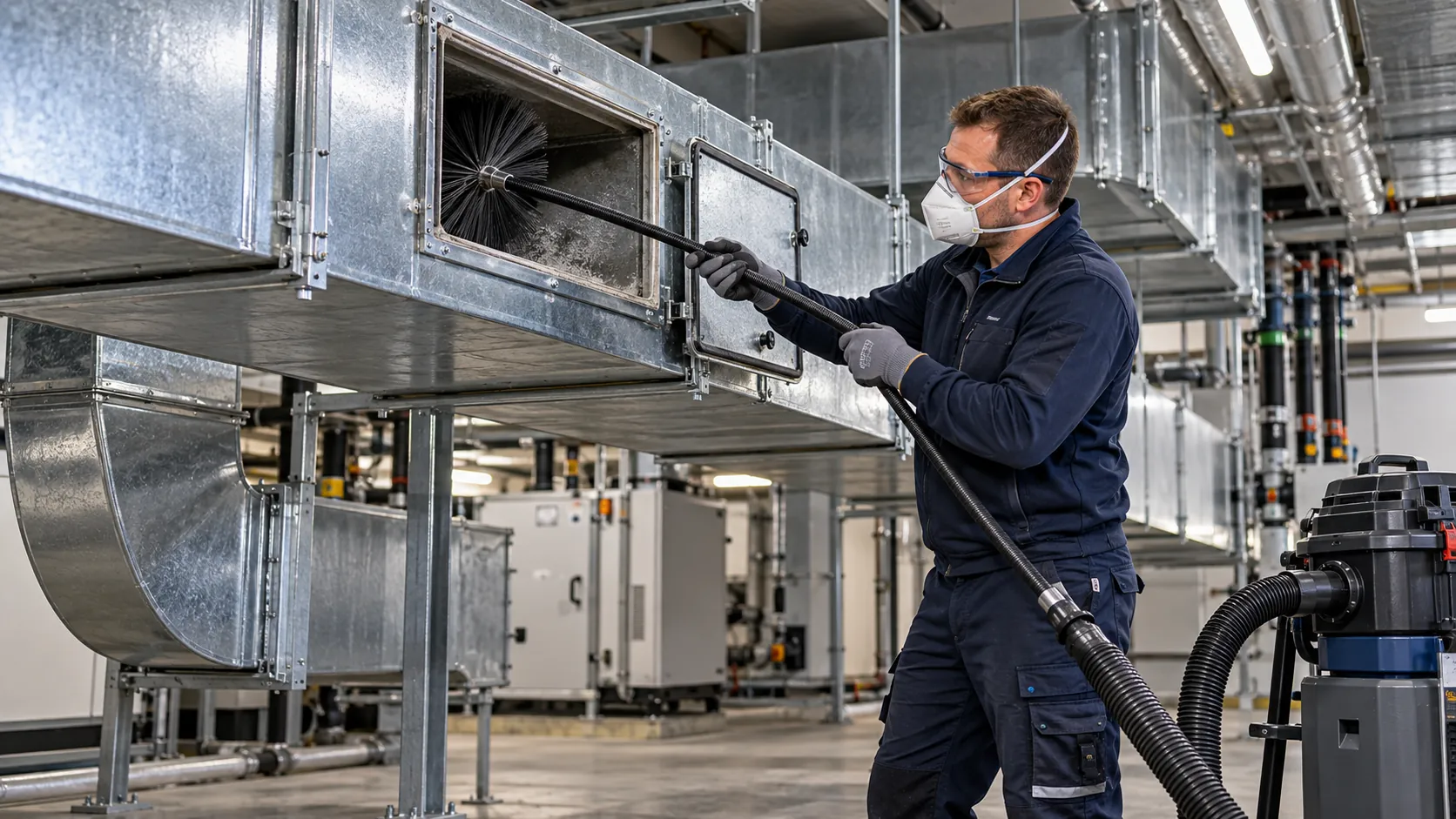
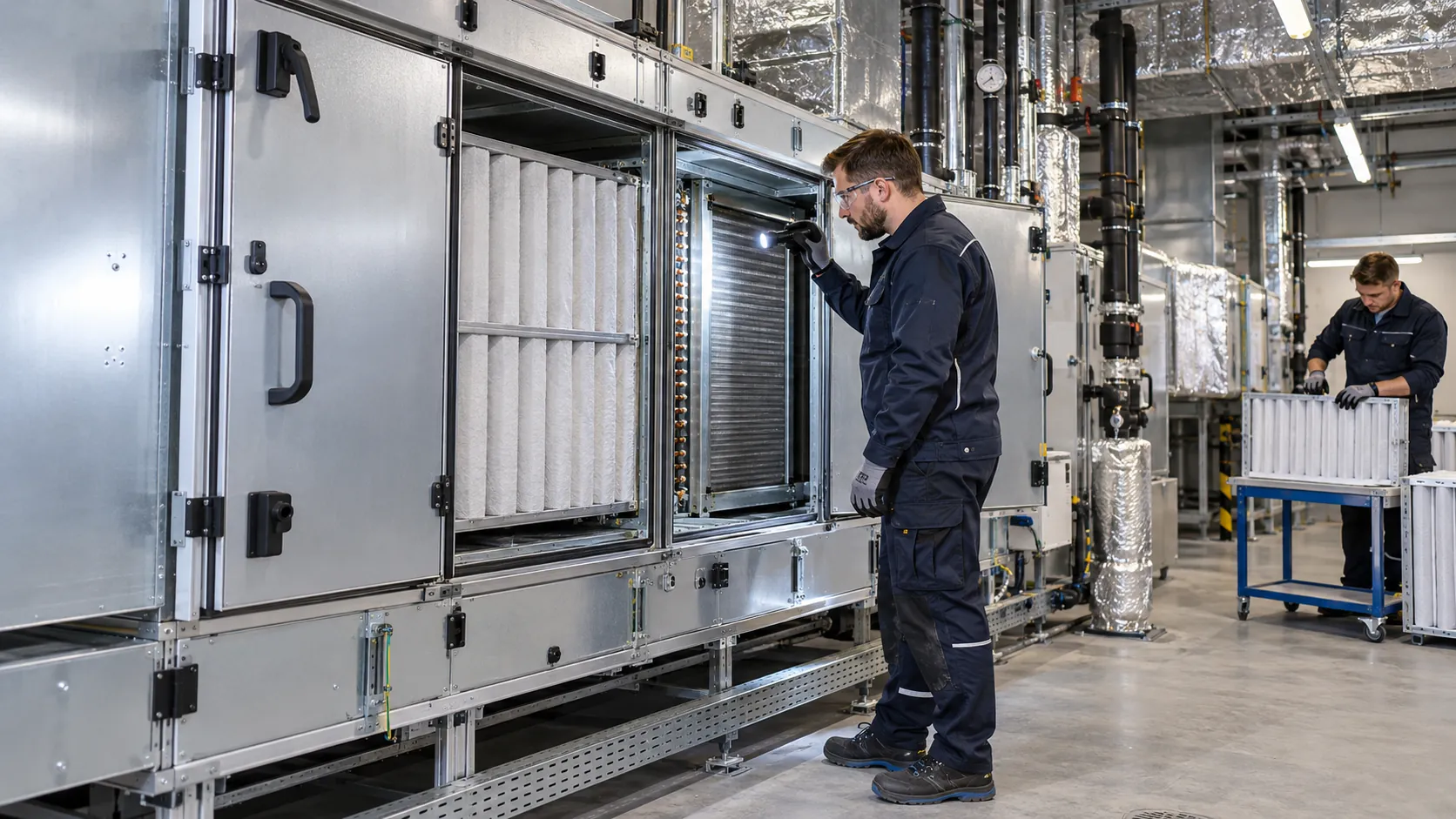
Hygiene inspection of an opened air handling unit with filter section and heat exchanger

Air handling systems to VDI 6022: hygiene inspection, cleaning and operator evidence

Hygiene inspection, cleaning and filter changes are three different processes. Anyone who combines them into one item loses the evidence they wanted to keep.

Arrange a site survey

Category
Ventilation and exhaust cleaning
Reachable
Mo–Fr 07:30–17:30 Uhr
Site visit
Free of charge, on site

In short

A hygiene inspection assesses the hygienic condition of an air handling system and derives measures from it; cleaning is one of those measures. A filter change is maintenance and replaces neither of the two. VDI 6022 is a private technical guideline and not a law: the assessment becomes obligatory through the operator's duty of care, the operator's hygiene plan and contractual requirements.

Problem und Lösung

The challenge

The trigger is usually a record, not the technology: an audit date is coming up, an insurer or an inspection body asks about system hygiene, users complain about odour from the outlets, or water damage in the air handling plant room forces action. Two misunderstandings recur regularly. First: 'we change the filters regularly, so hygiene is taken care of' – the filter change is maintenance on one assembly, while wet points such as humidifiers, cooling coils, condensate tray and droplet separators remain untouched; that is precisely where microbiological loads arise. Second: 'the hygiene inspection is a cleaning with a report' – the inspection is an assessment of the condition by personnel qualified for it. It can conclude that cleaning is necessary; conversely, cleaning can be carried out without a finding ever having been recorded and documented.

Our solution

First the commission is clarified: inspect only, clean only, or both – and which documents exist. The survey follows the air path from the outdoor air intake through filter stages, coils, humidifiers, condensate tray and droplet separators to the fan, silencer, ducts and outlets. Water-carrying components are assessed by their own yardstick: water flow, drainage gradient, deposits and standing water. Where commissioned, surface samples at the hygienically critical points are added; the sampling points belong in the report, because a measured value without location and method is not reliable. Cleaning then follows per component, mechanically, wet or dry – acoustic material and finned packs do not tolerate aggressive wet treatment. The filter change follows differential pressure and the manufacturer's specification, not the calendar, and is completed with a check of the sealing seat. The report describes the condition, anything unusual, the measures derived and, on request, laboratory results.

Scope of service

  • Hygienic assessment of the current condition: survey of all air-carrying assemblies from the outdoor air intake through filters, coils, humidifiers and fans to silencers and outlets.
  • Assessment of the water-carrying components: humidifiers, cooling coils, condensate tray and droplet separators, covering water flow, drainage gradient, deposits and standing water.
  • Sampling, where commissioned: surface samples at defined points. Evaluation is carried out by a suitable testing laboratory; the choice of laboratory should be specified by the client in the tender.
  • Cleaning of the assemblies: wiping, vacuum and wet methods depending on the component; fins, sealing seats and acoustic material are treated in a material-friendly way.
  • Condensate tray and drain: cleaning and checking of the gradient and the drainage function – here the water flow decides the hygienic condition.
  • Filter change and sealing seat: replacement according to the manufacturer's and system specification, checking of the sealing seat against bypass flow.
  • Documentation: finding report with a description of the condition, photographic documentation, irregularities and derived measures.
  • Handover of the measures: who implements the recommended work and how the result is carried forward in the operator's records has to be clarified in advance.
  • Scope boundary: cleaning of general ductwork without a hygiene reference is ventilation system cleaning, and grease-laden kitchen exhaust is kitchen exhaust cleaning to VDI 2052. The quotation and the order confirmation should list the items separately.

Typical subservices

  • Hygienic assessment of the current condition
  • Assessment of water-carrying components
  • Surface sampling
  • Cleaning of coils and finned packs
  • Condensate tray and drain
  • Filter change and sealing-seat check

Suitable for

  • Air handling systems with humidification or washers: water-carrying components are the hygienic focus. Evaporative humidifiers, spray humidifiers and circulating washers behave differently in operation.
  • Systems with recirculated or mixed air operation: if extract air is returned, particles, odours and germs circulate with it – assessing the return air route is part of the task.
  • Pure supply and extract systems without humidification: a more favourable starting position, but not free of hygiene. Fan chambers, silencers and condensate formation behind cooling coils remain relevant points.
  • Systems with heat recovery: cross-flow, rotary and plate heat exchangers place different demands on cleaning and on the assessment of possible leakage flows between extract and supply air.
  • Properties with increased protection requirements: clinics, care facilities, laboratories and cleanrooms combine general system hygiene with property-specific requirements.
  • Properties with evaporative cooling systems, cooling towers or wet separators: here it has to be examined for the individual property whether a statutory ordinance applies – that is a different category from a private guideline.

Your advantages

Tailored to this service – aligned with site and industry.

  • Three processes, three records

    Hygiene inspection, cleaning and filter change are described separately and listed separately. Only then does it remain traceable which record applies to what.

  • Wet points count double

    Water-carrying components are assessed by their own yardstick – that is where loads arise which a filter change does not touch at all.

  • The sealing seat is part of the effect

    A filter works only as well as it sits: bypass flow at seals and frames is a property of the system, not a cleaning result.

Process

How your project runs

  1. 1

    Clarifying the commission

    What is defined is whether only an inspection, only cleaning or both are commissioned, and which documents exist: system description, hygiene plan, maintenance history, earlier reports.

  2. 2

    Survey and condition recording

    What is assessed is the outdoor air intake, filter stages, coils, humidifiers, condensate tray, droplet separators, fan, silencers, ducts and outlets.

  3. 3

    Sampling, where commissioned

    Surface samples at the hygienically critical points. The sampling points are recorded in the report, because a measured value without location and method is not reliable.

  4. 4

    Cleaning of the affected assemblies

    Mechanical, wet or dry – depending on the material. Acoustic material and finned packs do not tolerate aggressive wet treatment.

  5. 5

    Filter change, sealing-seat check and report

    Replacement follows differential pressure and the manufacturer's specification, not the calendar. The report describes the condition, the measures and anything unusual, with laboratory results on request.

Methods and equipment

  • Visual inspection of all air-carrying assemblies along the air path, from the outdoor air intake to the outlet.
  • Assessment of water-carrying areas according to water flow, drainage gradient, deposits and standing water.
  • Surface sampling at defined sampling points documented in the report; laboratory evaluation where commissioned and handled through a suitable testing laboratory.
  • Cleaning per component with wiping, vacuum or wet methods, material-friendly on fins, sealing seats and acoustic material.
  • Filter change according to differential pressure and the manufacturer's specification, followed by a sealing-seat check against bypass flow.
  • Finding report with a description of the condition, photographic documentation, irregularities and derived measures.

Technical and legal framework

This service sits within a framework of statutory duties, technical rulebooks and operational practice. The distinction matters because it determines who is responsible for what.

Legal status of VDI 6022
VDI 6022 is a guideline series of the Association of German Engineers on hygiene requirements for air handling systems and units – a private technical guideline and not a legal norm. No immediate statutory duty arises from it; the wording 'legally required under VDI 6022' misstates the legal position. Professional review of the standard in its full text is required.
What actually creates the duty
The Ordinance on Workplaces requires workplaces to be maintained so that hazards are avoided, and contamination and deposits that can lead to immediate danger to be removed. The Occupational Health and Safety Act requires a risk assessment and measures at the source; for biological agents the Biological Agents Ordinance applies. DGUV Vorschrift 1 binds member businesses directly. The interval binding for a particular property is set by the operator in the hygiene plan – not by the guideline and not by the contractor.
Who may carry out the assessment
The guideline series distinguishes personnel categories with different areas of activity: who may assess and who carries out maintenance and cleaning work are not the same. The requirements for training and further qualification belong in the full text and have to be checked there – professional review of the standard in its full text is required. Ask for concrete evidence, therefore, rather than trusting self-descriptions.
42. BImSchV – only where its scope applies
Depending on their design, evaporative cooling systems, cooling towers and wet separators can fall within the scope of the Ordinance on Evaporative Cooling Systems, Cooling Towers and Wet Separators. That is a statutory ordinance and therefore a different category from a private guideline; operator duties and recurring inspections then follow from it. Whether it applies to your system has to be examined for the individual property and cannot be answered in general terms.
The report is a finding document
The contractor describes the condition, the sampling and the measures derived. It does not issue an official approval and does not replace an official inspection. Whether a report suffices as evidence in an individual case is decided by the body making the enquiry – insurer, auditor, authority or client. Statements about the personal qualification of individual employees are not made here.

The rulebooks named here describe requirements for how the work is carried out – they are not a certification held by BREREI. VDI and DIN normative texts are chargeable and were not available in full; where a statement touches the normative detail, this is noted in place.
What determines the interval

  • Design and use: water-carrying components, the recirculated air proportion and the intensity of use determine the risk. The guideline series distinguishes by system type, in particular by whether humidification is present; the concrete periods belong in the full text and are not quoted here.
  • Result of the last assessment: an irregular finding shortens the interval; a finding that has been unremarkable over several cycles argues for keeping the rhythm rather than shortening it.
  • Condition of the filter stages and the sealing seat: differential pressure development and visible bypass flows show whether maintenance has to be adjusted.
  • Quality of day-to-day maintenance: wet points that are kept dry and checked regularly remain unremarkable for longer.
  • Property requirements: clinics, laboratories, cleanrooms, data centres and food businesses often have tighter requirements from standards, approvals or audit requirements.
  • Hygiene plan and risk assessment: this is where the interval binding for the property is set – not in a contractor's brochure.

What determines the effort and the quotation

  • Number and size of the air handling units and the associated air ducts
  • Design with or without humidification, with or without recirculated air – this determines which components have to be assessed
  • Number, condition and reachability of the accessible inspection openings and of the individual assemblies
  • Whether only an inspection, only cleaning or both are commissioned; the items should be listed separately in the quotation
  • Scope of sampling, number of sampling points and the laboratory evaluation required
  • Degree of contamination and the material-specific effort on acoustic material, finned packs and sealing seats
  • Scaffolding, aerial work platforms or work outside operating hours
  • Scope of documentation and the form in which data is handed over; plus the preconditions you create – documents, access to the plant room, a regulated shutdown and named contacts

Applicable standards and regulations

  • Ordinance on Workplaces (ArbStättV) – legally binding
  • Occupational Health and Safety Act (ArbSchG) – legally binding
  • Biological Agents Ordinance (BioStoffV) – legally binding
  • 42. BImSchV – statutory ordinance, legally binding where its scope applies
  • DGUV Vorschrift 1 – accident prevention regulation, binding on member businesses
  • DIN EN 15780 – standard, binding only through contract, legal reference or presumption effect
  • DIN EN ISO 16890 – standard, binding only through contract, legal reference or presumption effect
  • VDI 6022 (guideline series) – VDI guideline, not a legal norm; takes effect through contract, insurance condition or customary practice
  • Manufacturer and maintenance specifications – manufacturer specification, takes effect through the purchase and maintenance contract

These references describe the requirements the work is performed against. They are not a certification, inspection or approval held by BREREI.

Frequently asked questions about this service

Short answers to help you assess whether this service fits your site.

Is VDI 6022 legally binding?

No. VDI 6022 is a private technical guideline, not a legal norm. A duty arises through the duty of care and occupational health and safety law – for example the Ordinance on Workplaces or the Biological Agents Ordinance – through accident prevention regulations for member businesses, or through contractual agreements. Anyone who describes the pure guideline as a law is arguing incorrectly.

What is the difference between hygiene inspection, cleaning and filter change?

The hygiene inspection is an assessment: qualified personnel examine the condition of the system, document anything unusual and derive measures. The cleaning is the implementation of those measures. The filter change is maintenance on one assembly and is neither of the two. For the operator the distinction matters, because the records, the responsibilities and the quotation items differ.

Who may carry out a hygiene inspection?

The guideline series distinguishes personnel categories with different areas of activity – who may assess and who may carry out maintenance and cleaning work are not the same. The exact requirements for training and further qualification belong in the full text and have to be checked there (professional review of the standard in its full text is required). Clients should request evidence specifically instead of trusting self-descriptions.

Is a regular filter change enough?

No. Filter changes address particle load and pressure loss. Hygienic priorities additionally lie in water-carrying components and in areas behind the filter, such as fan chambers, silencers and condensate trays. A filter that sits cleanly also improves nothing if it is bypassed because the sealing seat is not tight – effectiveness is a property of the system, not only of the filter medium.

How often does an air handling system have to be hygienically assessed?

The guideline series assigns different intervals to the different system types; the concrete periods have to be checked in the full text and are not quoted here. For the individual property the operator sets the interval in the hygiene plan and in the risk assessment – taking into account the design, the last finding and the requirements from an audit or a contract.

Which documents does the operator receive, and what can they be used for?

The operator receives a finding report with a description of the condition, the irregularities identified, photographic documentation and recommended measures, with laboratory results from the sampling on request. This report documents the assessment that was carried out and is the basis for the operator's own records. It is not an official approval and not a confirmation of conformity of the building or the operator.

Hygiene inspection, cleaning or both?

If you want to clarify whether an assessment, a cleaning or both are required, arrange a site survey. Bring the system documents and the most recent maintenance records; from these the scope can be described more precisely. There are no commitments on costs, dates or response times here.

Prefer to talk?

0421 87757597

Mon–Fri, 07:30–17:30 – we are happy to call you back.

Request a quote in two minutes

Service, property and contact details – that is all we need.

Or use the full contact form